
Overview
April 2026 was a month ranking in the top ten for warmth, yet the major weather news of the month was a damaging late-month freeze. Weeks vacillated between warmth and cold, with the warm ones winning out. This thermal whiplash was accompanied by yet another below-normal month of precipitation, making this 21 of the past 24 months with below-normal totals across the Garden State. A Drought Warning issued by the NJ Department of Environmental Protection remains in place.
The 54.4° average April temperature is 2.9° above the 1991–2020 normal. This ties as the 6th mildest since records commenced in 1895. Seven of the ten mildest Aprils have occurred since 2002, with 2006 (12th) and 2025 (13th) not far behind (Table 1). The average high of 66.4° is 3.7° above normal, ranking 6th mildest, and the average low of 42.4° is 2.1° above normal, ranking 7th mildest. The northern climate division averaged 52.9° (+3.0°, 6th mildest), the southern division 55.5° (+2.9, 6th mildest), and the coastal division 54.2° (+2.5°, 8th mildest).
| Rank | Year | April Avg. Temp. |
|---|---|---|
| 1 | 2017 | 55.9° |
| 2 | 2010 | 55.5° |
| 3 | 2023 | 55.4° |
| 4 | 1921 | 55.3° |
| 5 | 2019 | 54.8° |
| 6 | 2026 | 54.4° |
| 6 | 1941 | 54.4° |
| 8 | 2011 | 53.9° |
| 8 | 2002 | 53.9° |
| 10 | 1994 | 53.7° |
| 11 | 1960 | 53.6° |
| 12 | 2006 | 53.4° |
| 13 | 2025 | 53.3° |
| 13 | 1945 | 53.3° |
| 13 | 1913 | 53.3° |
Table 1. The 15 mildest Aprils across NJ since 1895.
April precipitation averaged 2.51” across NJ. This is 1.19” below normal and ranks as the 23rd driest. The northern division averaged 2.84” (-1.06”, 39th driest), southern 2.31” (-1.27”, 18th driest), and coastal 2.33” (-1.22”, 25th driest). Northwest areas were closest to normal, with west central and far southern reaches driest (Figure 1). Only trace amounts of snow and sleet were observed in several locations during the month.
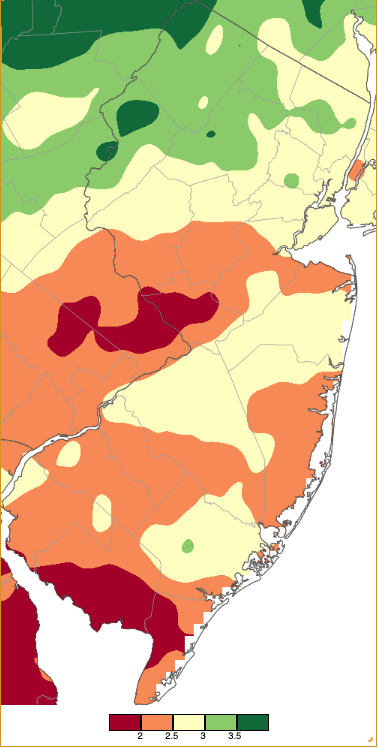
Figure 1. April 2026 precipitation across New Jersey based on a PRISM (Oregon State University) analysis generated using NWS Cooperative, CoCoRaHS, NJWxNet, and other professional weather station observations from 8 AM on March 31st to 8 AM on April 30th. Note the scale in inches at the bottom of the map. Totals range from 1.50”–1.99” (dark red) to 3.50”–3.99” (dark green).
Temperature
Exemplifying the frequent wide swings of the thermometer, nine April afternoons found temperatures of 80° or higher at multiple stations within the 70-station Rutgers NJ Weather Network (NJWxNet). This, while eleven days saw low temperatures below the freezing point. Only one day ≥80° was separated by more than three days from a freeze, that being the 1st, coming five days before the first April freeze. Only two freezing days were as many as four days from a ≥80° day.
The high topped out at 86° in Hammonton (Atlantic County) on the 1st, with 43 WxNet stations reaching 80°–85°. The still cool ocean kept the high at 63° at Atlantic City Marina (Atlantic). Cherry Hill (Camden) hit 85° on the 4th with 18 locations from 80°–85°. Following a week of cold conditions, the temperature rose to 82° in Haworth (Bergen) and 80°–81° at 39 WxNet stations on the 13th. Sicklerville (Camden) topped out at 90° on the 14th, the first location to reach that mark in 2026, and sixty-two stations made it from 80°–89°. Thirty-seven stations reached 90° or higher on the 15th, led by five at 92°. The 91° high at Newark-Liberty Airport in Elizabeth (Union) was a record, exceeding the previous record of 88° in 1960. The 88° high at Trenton-Mercer Airport in Ewing Township (Mercer) exceeded the previous record of 82° in 2012. The 15th, like multiple others this month, exhibited notable rapid temperature fluctuations at coastal locations as sometimes only subtle changes in wind direction led to changes of 20° or greater in just minutes. Such was the case at Sea Girt (Monmouth) multiple times on this day (Figure 2). Meanwhile, Harvey Cedars (Ocean) never made it past 70°.
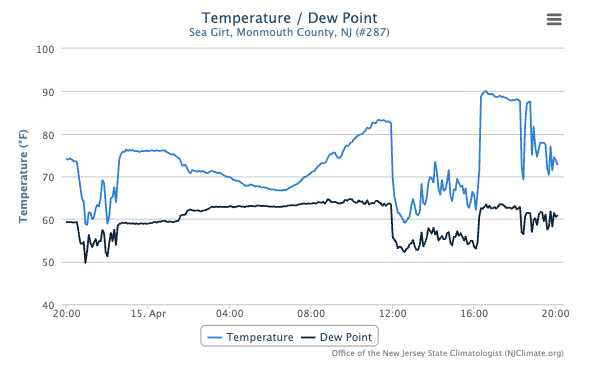
Figure 2. Time series of air temperature and dew point at the Sea Girt NJWxNet station from 8 PM April 14th to 8 PM April 15th.
The early-season heatwave climaxed on the 16th, with Fort Dix (Burlington) up to 94°, 36 stations from 90°–93°, and 18 from 80°–89° (Figure 3). The 91° at the Atlantic City Airport in Pomona (Atlantic) exceeded the previous record of 89° in 2002. Harvey Cedars only made it to 66°. Mid-afternoon temperatures demonstrated the cooling effects close to the coast as the rising hot inland air helped pull in cooler air sitting over coastal waters (Figure 4). Witness the 91° reading at Oswego Lake (Burlington) 20 miles from the 53° observation at Harvey Cedars. Cooler conditions began to arrive on the 17th, with four stations up to 85° and 42 sites from 80°–84°.
One last warm spell arrived before April made a final turn toward cooler-than-normal conditions. The 80° mark was reached at Hammonton, Sicklerville, and Upper Deerfield (Cumberland) on the 23rd, with that value duplicated on the 24th at Sicklerville and Vineland (Cumberland).
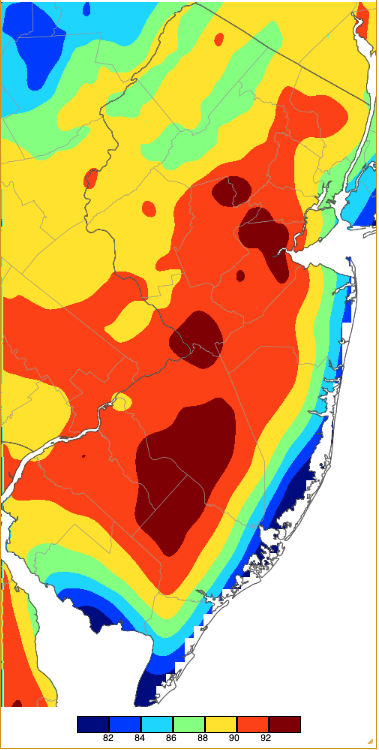
Figure 3. Maximum temperatures on April 16th based on a PRISM (Oregon State University) analysis generated using NWS, NJWxNet, and other professional weather stations. Note the 2° scale beneath the map.
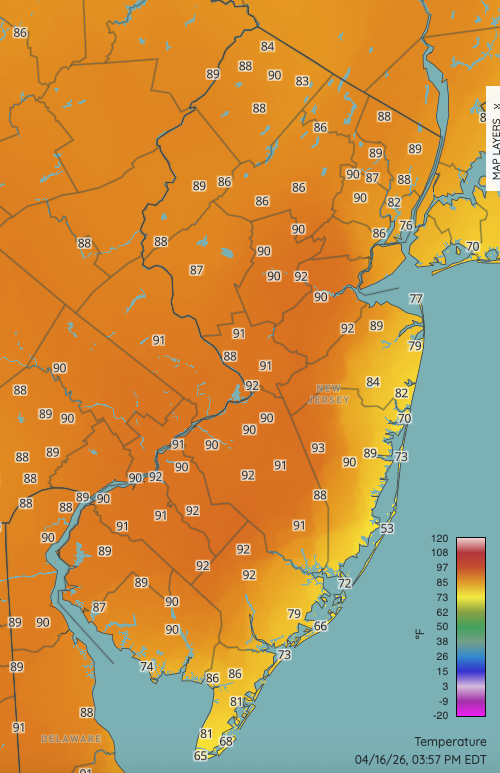
Figure 4. NJWxNet map showing temperatures across NJ and surroundings at 3:57 PM on April 16th as a strong sea breeze results from an early-season heatwave.
Subfreezing temperatures occurred over six of seven days from the 6th–12th, from the 19th–21st, and the 27th–28th. High Point Monument (Sussex) fell to 31° and Pequest (Warren), Walpack (Sussex), and Sandyston (Sussex) all 32° on the 6th. High Point Monument again led the way at 22° on the 7th, with 18 NJWxNet stations from 25°–32°. The 8th was the coldest April morning with Walpack bottoming out at 15°, High Point Monument 17°, eight sites from 20°–24°, and 57 from 25°–32° (Figure 5). The only NJWxNet station above freezing was Harvey Cedars at 34°.
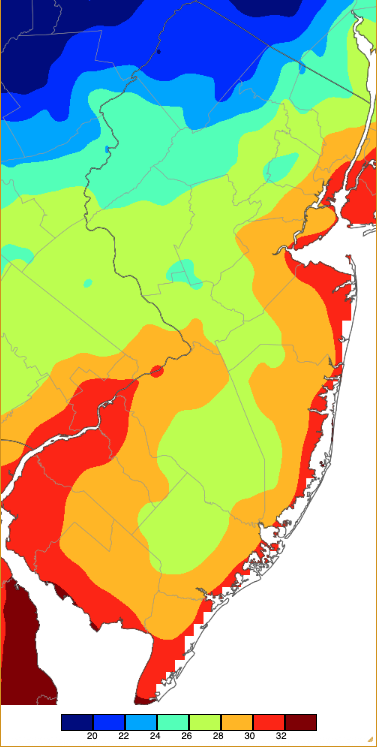
Figure 5. Minimum temperatures on April 8th based on a PRISM (Oregon State University) analysis generated using NWS, NJWxNet, and other professional weather stations.
The cold morning of the 9th saw Berkeley Township (Ocean) down to 19°, 15 stations from 20°–24°, and 44 from 25°–32°. Walpack fell to 29° and four stations either 31° or 32° on the 10th, and Walpack 25° and four stations either 31° or 32° on the 12th.
Another cold spell arrived on the 19th, with Sandyston down to 30° and nine locations from 31°–32°. Berkeley Township hit 26° on the 20th, with 39 stations from 27°–32°. The 31° low at the Atlantic City Airport tied with 1981 and 1989 as a record. While not as cold as the 8th, the lows on the 21st were critically more impactful than those earlier in the month. Walpack dipped to 19°, 14 stations from 21°–24°, and 42 from 25°–32°. Seaside Heights (Ocean) was mildest at 37° (Figure 6). The low at the Trenton-Mercer Airport of 27° broke the previous record of 30° reached in 1907 and 1925. Below-freezing conditions during April 20th–21st persisted for more than 10 hours at many locations, with ≤24° readings for as many as 4 hours at Pequest, 3 hours at Hillsborough-Duke (Somerset) and Hopewell Township (Mercer), and 2 hours at Cream Ridge (Monmouth) and Berkeley Township. While a full assessment of damages from this hard freeze is yet to be completed, suffice it to say that this one of the most widespread disasters on record to strike most every fruit growing tree, bush, or vine in the state. The horticultural industry also appears to have taken a notable hit. Damage totals may approach $100 million. This situation was no doubt made worse because it occurred less than a week after temperatures were 90° at many of these locations.
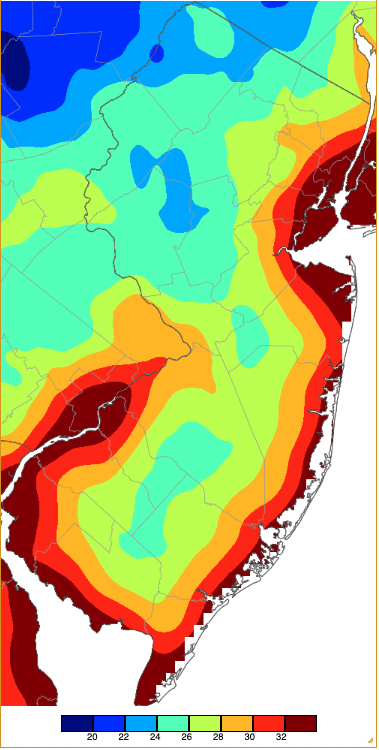
Figure 6. Minimum temperatures on April 21st based on a PRISM (Oregon State University) analysis generated using NWS, NJWxNet, and other professional weather stations.
Towards month’s end, Walpack and Berkeley Township each dropped to 31° on the 27th, with seven other sites 32°. Berkeley Township fell to 30° on the 28th, with Hopewell Township 31°, and from the far south to north, Woodbine (Cape May), Oswego Lake, and Walpack each 32°.
A final look at the impact of nearby chilled Atlantic waters on New Jersey’s spring weather is illustrated by three mid-afternoon maps on the 18th, a day wedged between recent heat and the upcoming freeze (Figure 7). The eastern half of the state was in the upper 40°s to low 60°s while the western half from the mid 60°s to low 70°s (top map). This gradient was driven by modest easterly winds ushering in cooler air (middle map). This is not a local sea breeze effect, rather one driven by a broader synoptic weather pattern. Accompanying the cool easterly flow was enough moisture to usher a bank of clouds from 10 to 30 miles inland where temperatures were in the low to mid 50°s (bottom map).
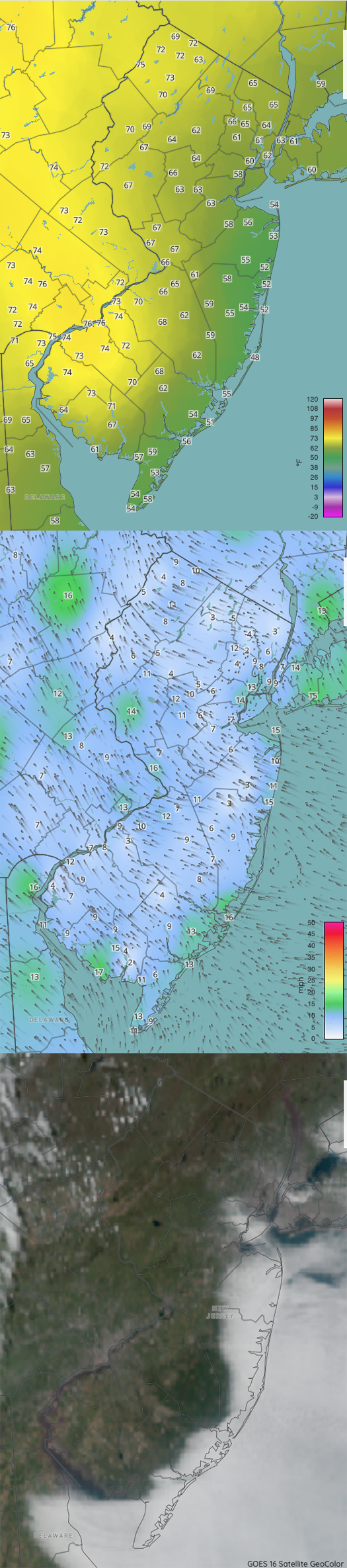
Figure 7. NJWxNet maps showing conditions across NJ and surroundings at 3:07 PM on April 18th as persistent easterly winds brought lower temperatures and cloud cover to coastal sections while clear skies and warmer temperatures are found inland. Top: Air temperature. Middle: wind speed at individual stations and wind vectors showing the speed and direction of winds. Bottom: visible satellite image.
Precipitation and Storms
April precipitation at Community Collaborative Rain, Hail, and Snow Network (CoCoRaHS) stations ranged twofold. The wetter northwest found Frelinghuysen Township (Warren) at 3.87”, two Vernon Township (Sussex) sites 3.79” and 3.67”, Mine Hill Township (Morris) 3.73”, Mount Arlington (Morris) 3.68”, Blairstown Township (Warren) 3.67”, Montague (Sussex) 3.66”, and Newton (Sussex) 3.54”. On the low end, Millville (Cumberland) came in with just 1.58”, Two Middle Township (Cape May) stations with 1.64” and 1.75”, Woodbine 1.74”, two Pennington (Mercer) sites at 1.78” and 1.85”, and two Ewing Township stations at 1.82” and 1.83”.
The first precipitation event of the month began with some showers late on the 1st into the pre-dawn of the 2nd before ending with some daytime drizzle. Some thunder was heard in southern counties. Of 253 CoCoRaHS reports, Franklin Township (Gloucester) received the most at 1.35”, Pittsgrove Township (Salem) 1.32”, Monroe Township (Gloucester) 1.24”, with 11 sites catching 1.00”–1.35” and 59 from 0.50”–0.99”. West Windsor Township (Mercer) with 0.08” saw the least. A gust of 44 mph occurred in Greenwich (Cumberland). Afternoon showers on the 4th transitioned to fog and drizzle early on the 5th before ending as rain with some embedded thunder during the daytime hours. Middle Township caught 1.21”, four Lower Township (Cape May) observers reported from 0.86” to 0.68”, Ventnor City (Atlantic) 0.74”, and 22 stations from 0.50”–0.86”. Windy conditions accompanied and followed this system, with gusts to 51 mph at Cream Ridge, Pennsauken (Camden) 47 mph, Logan (Gloucester) 41 mph, and Columbus (Burlington) 40 mph on the 5th, High Point Monument 42 mph and Pennsauken 41 mph on the 6th, and Lower Alloways Creek Township (Salem) 42 mph on the 7th.
Some graupel was reported in Vernon Township in a light shower on the 8th. Next up were some scattered afternoon and evening showers on the 16th depositing 0.58” in Maywood (Bergen), Frelinghuysen Township 0.46”, and Blairstown Township 0.39”. Some quick early-afternoon showers with some thunder on the 17th brought 0.62” and 0.49” to two Vernon Township sites, Montville Township (Morris) 0.44”, and Tenafly (Bergen) 0.41”.
Pre-dawn and mid- to late-afternoon showers on the 19th brought Frelinghuysen Township 0.68”, Stillwater Township (Sussex) 0.67”, Blairstown Township 0.63”, and 11 stations 0.50”–0.68”. Afternoon flurries were observed in Hardyston (Sussex) and Wantage (Sussex), and sleet in Randolph Township (Morris). Wind gusts to 45 mph at Harvey Cedars, Little Egg Harbor Township (Ocean) 42 mph, and 40 mph at both Fortescue (Cumberland) and High Point Monument occurred on the 19th, with a gust to 40 mph at Little Egg Harbor Township on the 20th, rounding out the six days with 40 mph plus gusts this month.
Rainfall from predawn on the 25th to predawn on the 26th was by far the most plentiful and, given statewide drought conditions, welcome precipitation event of the month. Of 259 CoCoRaHS station reports, Hawthorne (Passaic) received the most with 1.83”, followed by Morris Township (Morris) 1.81”, Maplewood (Essex) 1.78”, Springfield Township (Union) 1.78”, Harrison (Hudson) 1.75”, 138 stations from 1.00”–1.74”, and 71 from 0.50”–0.99” (Figure 8). Lower Township with 0.21” received the least.
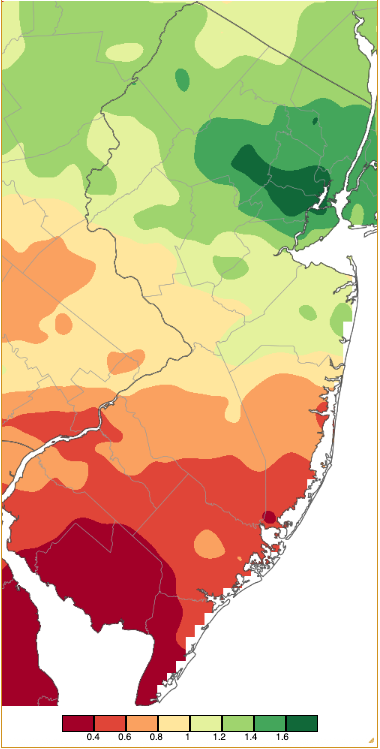
Figure 8. Precipitation across New Jersey from 8 AM on April 24th through 8 AM April 26th based on a PRISM (Oregon State University) analysis generated using NWS Cooperative, CoCoRaHS, NJWxNet, and other professional weather station observations. Note the scale in inches beneath the map.
More beneficial rain fell from the evening of the 29th to the predawn hours of the 30th, accompanied by thunder at some locations. Neptune Township (Monmouth) led the way with 0.99”, followed by Bradley Beach (Monmouth) and Neptune City each with 0.87”, Jackson Township (Ocean) 0.86”, and an impressive 179 stations from 0.50”–0.84” (Figure 9).
The highest barometric pressures were observed on the 8th, ranging from approximately 30.60”–30.70”. The month’s lowest pressures were mainly from 29.70”–29.75” on the 16th and 30th.
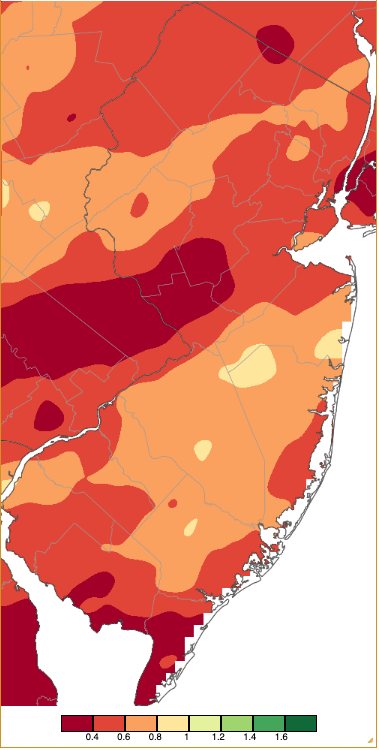
Figure 9. Precipitation across New Jersey from 8 AM on April 29th through 8 AM April 30th based on a PRISM (Oregon State University) analysis generated using NWS Cooperative, CoCoRaHS, NJWxNet, and other professional weather station observations.
The US Drought Monitor map of April 28th showed some degradation of conditions from the start of the month (Figure 10). The majority of NJ was deemed to be in moderate drought (D1), with several portions of the south in severe drought (D2). The NJ Department of Environmental Protection continues with a Drought Warning for the entire state.
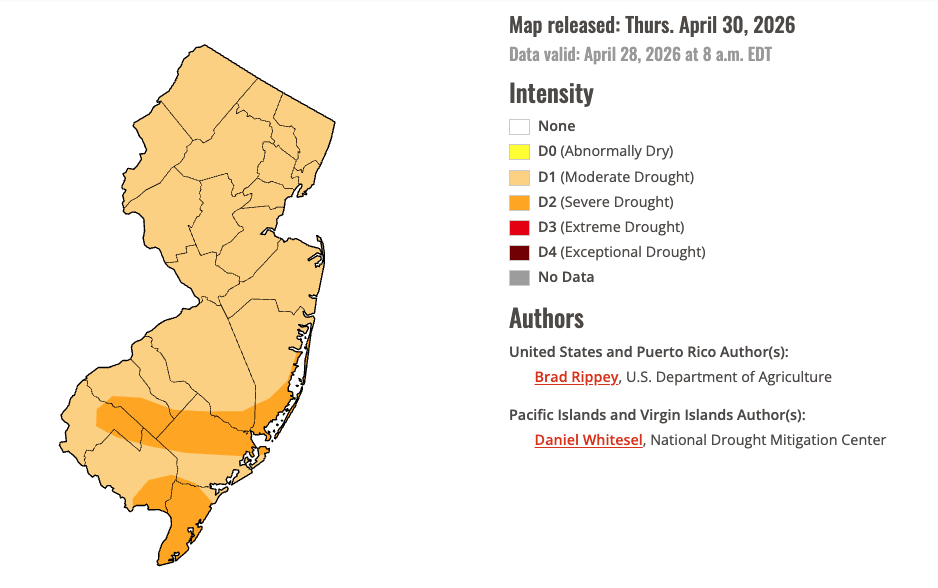
Figure 10. U.S. Drought Monitor map of conditions in NJ as of April 28, 2026.
2025–2026 Snow Season
This was a season that snow lovers have been hoping for following a few “weak” ones. Statewide, the average snowfall was 37.9”. This is 12.6” above normal and ranks as the 21st snowiest of the past 132 seasons (Figure 11). The distribution of snowfall was more uniform than normal, with totals within 10” of 40” common in the northern three quarters of the state. While the northwest had more frequent snowfalls, several of the heaviest falls were toward the south and east. The northern snow division (Warren-Morris-Essex counties northward) averaged 47.0” (+11.2”, 27th snowiest), the central division (Hunterdon-Somerset-Union-Middlesex-Monmouth-Mercer) averaged 42.9” (+14.5”, 21st snowiest), and the southern division (Burlington-Ocean southward) averaged 30.6” (12.0”, 23rd snowiest).
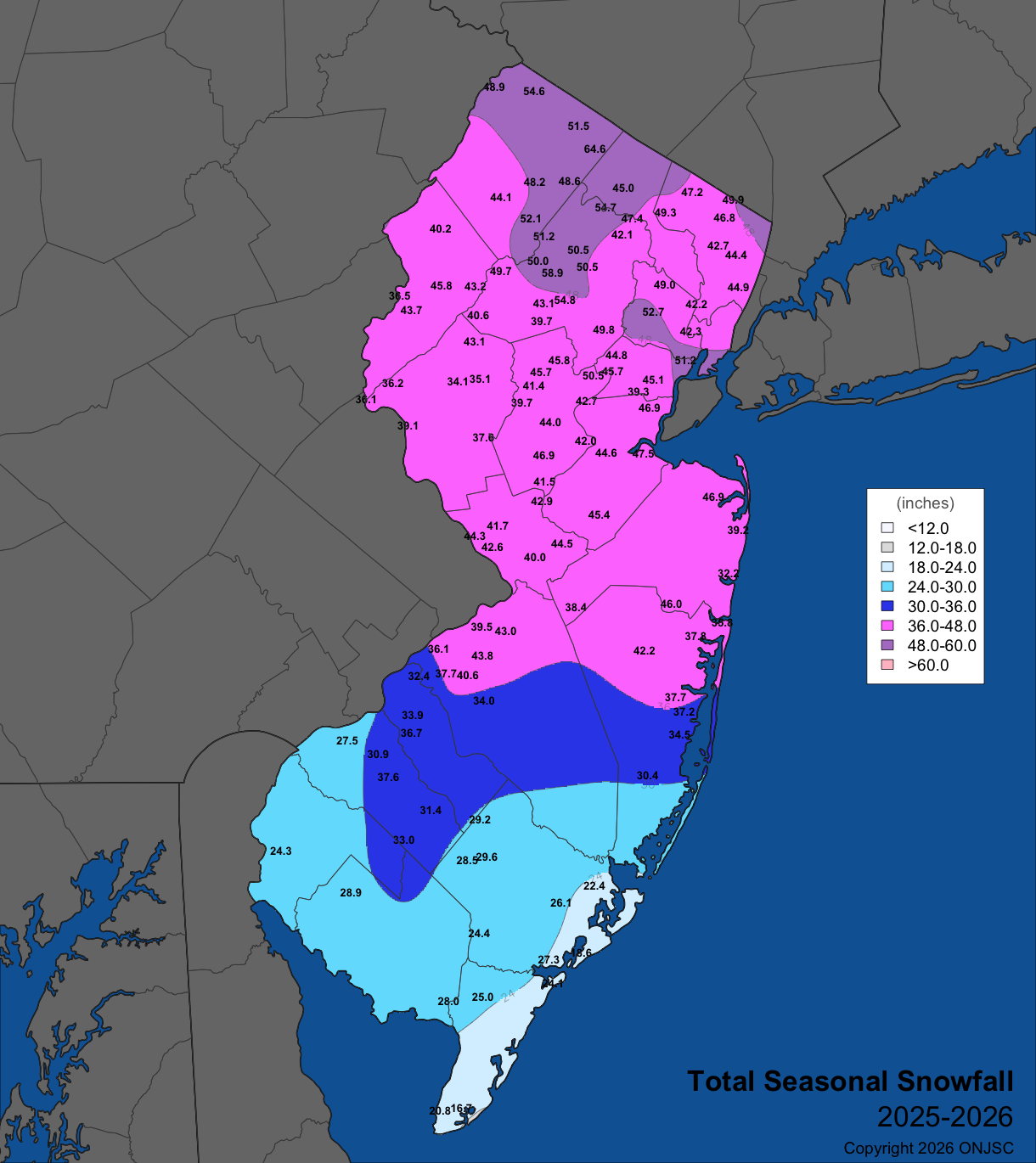
Figure 11. Seasonal snowfall (November 2025–April 2026). Observations are from CoCoRaHS, NWS Cooperative Observer, and North Jersey Weather Observers reports.
Just as in the previous year, over the course of the season, 11 events brought 2.0” or more to at least one NJ reporting location (CoCoRaHS, NWS Coop, NWS Spotter). The first two occurred in the northwest. Subsequent top totals vacillated between northern and central areas. Four events found measurable snow ≥1.0” accumulating at stations in every county. Two of the last three events of the season were the largest, especially the blockbuster storm of February 22–23, with a top total of 26.5 measured in Strathmore (Monmouth), ≥20.0” at locations in eight counties, and ≥10.0” in every county except Warren.
| Date | Top Total | Location (County) | Counties ≥ 0.1” | Counties ≥ 1.0” |
|---|---|---|---|---|
| Dec. 2 | 4.7” | Montague Township (Sussex) | 4 | 4 |
| Dec. 10 | 2.2” | Frelinghuysen Township (Warren) | 4 | 3 |
| Dec. 13–14 | 8.5” | Howell Township (Monmouth) | 21 | 21 |
| Dec. 23 | 4.0” | Highland Lakes (Sussex) | 15 | 9 |
| Dec. 26–27 | 5.1” | Highland Lakes | 17 | 14 |
| Dec. 31–Jan. 1 | 2.0” |
Jefferson Township (Morris) Mine Hill Township (Morris) Randolph Township (Morris) Rockaway (Morris) |
20 | 4 |
| Jan. 17 | 5.4” | Highland Lakes | 16 | 13 |
| Jan. 18 | 4.8” | Holland Township (Hunterdon) | 21 | 21 |
| Jan. 25 | 18.0” | Vernon Township (Sussex) | 21 | 21 |
| Feb. 15–16 | 2.5” | Liberty Township (Warren) | 15 | 11 |
| Feb. 22–23 | 26.5” | Strathmore (Monmouth) | 21 | 21 |
Table 2. Recap of the New Jersey snow season: November 2025–April 2026.