
February Overview
The adage “wash, rinse, repeat” is an appropriate one when reviewing New Jersey’s weather and climate conditions over this past winter. There were multiple snowstorms and cold spells throughout the season, with below-normal precipitation (rain and melted snow/sleet) in each month as the state continues to experience drought conditions that date back almost two years. All this will be covered in a seasonal overview later in this report. First, a recap of conditions in a February that exemplifies what all months experienced this past winter.
The statewide February temperature averaged 29.6°. This is 4.3° below the 1991–2020 normal and ranks as the 46th coldest February dating back to 1895. The average high temperature of 37.9° is 5.2° below normal and ranks 35th coldest. The average low of 21.4° is 3.2° below normal, ranking 55th coldest. On a regional basis, the northern climate division averaged 27.1° (-4.2°, 47th coldest), the southern division 31.2° (-4.3°, 44th coldest), and the coastal division 31.5° (-4.5°, 40th coldest).
Precipitation averaged 2.01” across NJ, 0.85” below normal and tied with three other years for the 23rd driest February. This marked 19 of the most recent 22 months with below-normal precipitation. More on this is provided in the winter section of this report. February divisional results found the north averaging 1.64” (-1.15”, 12th driest), the south 2.19” (-0.70”, 32nd driest), and coast 2.66” (-0.41”, 56th driest). The southern coast was wettest and the northwest driest (Figure 1).
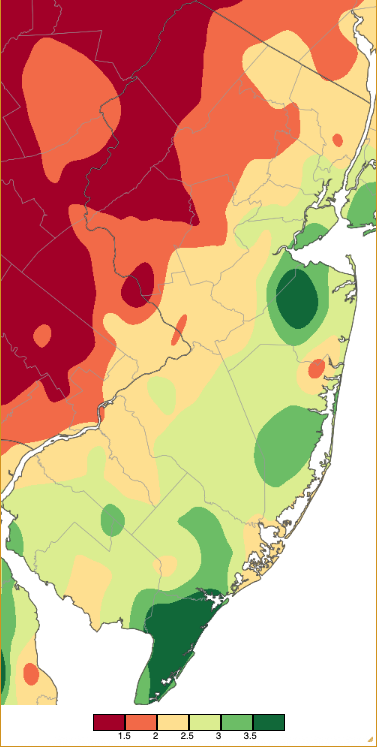
Figure 1. February 2026 precipitation across New Jersey based on a Northeast Regional Climate Center analysis generated using NWS Cooperative, CoCoRaHS, NJWxNet, and other professional weather station observations from 7 AM on January 31st to 7 AM on February 28th. Note the scale in inches at the bottom of the map. Totals range from 1.00”–1.49” (dark red) to 3.50”–3.99” (dark green).
February snowfall averaged 16.1” across NJ. This is 7.9” above the 1991–2020 normal, ranking as the 18th snowiest since 1895. The northern snow region averaged 15.6” (+5.2”, 29th snowiest), the central region 17.8” (+8.7”, 18th snowiest), and the southern region 15.6” (+8.9”, 12th snowiest). This was the snowiest February since 2021.
Precipitation and Storms
An examination of several hundred Community Collaborative Rain, Hail, and Snow Network (CoCoRaHS) stations found that the most precipitation fell in coastal Woodbine (Cape May County) with 3.93”. This was followed by Ocean City (Cape May) 3.84”, Berkeley Township (Ocean) 3.69”, Linwood (Atlantic) 3.68”, and Stafford Township (Ocean) 3.55”. The northwest dryness was led by Blairstown (Warren) at 1.18”, Greenwich Township (Warren) 1.22”, Clinton Township (Hunterdon) 1.25”, Liberty Township (Warren) 1.27”, and Newton (Sussex) 1.28”. The month’s largest snowfall totals were found in Howell (Monmouth) with 26.1”, Tenafly (Bergen) 25.1”, Jersey City (Hudson) 24.9”, Monroe Township (Middlesex) 24.9”, and Red Bank (Monmouth) 23.8”.
While not bringing any precipitation to the state, an offshore low-pressure system produced wind gusts on the 1st of 45 mph at Wantage (Sussex), High Point Monument (HPM; Sussex) 44 mph, Little Egg Harbor Township (LEHT; Ocean) 42 mph, and Harvey Cedars (Ocean) 41 mph. This continued into the 2nd with a 46-mph gust at Wantage and 40 mph at HPM. Snow showers late on the 6th into the morning of the 7th ushered in cold and windy conditions. Statewide winds and lowering windchills on the 7th brought a peak gust of 62 mph at LEHT, HPM 58 mph, five Rutgers NJ Weather Network (NJWxNet) stations gusting from 50–57 mph, and 25 stations from 40–49 mph (Figure 2). The 8th saw a gust of 54 mph in Wantage, with five stations from 40–49 mph. Wantage gusted to 46 mph and HPM 42 mph on the 9th.
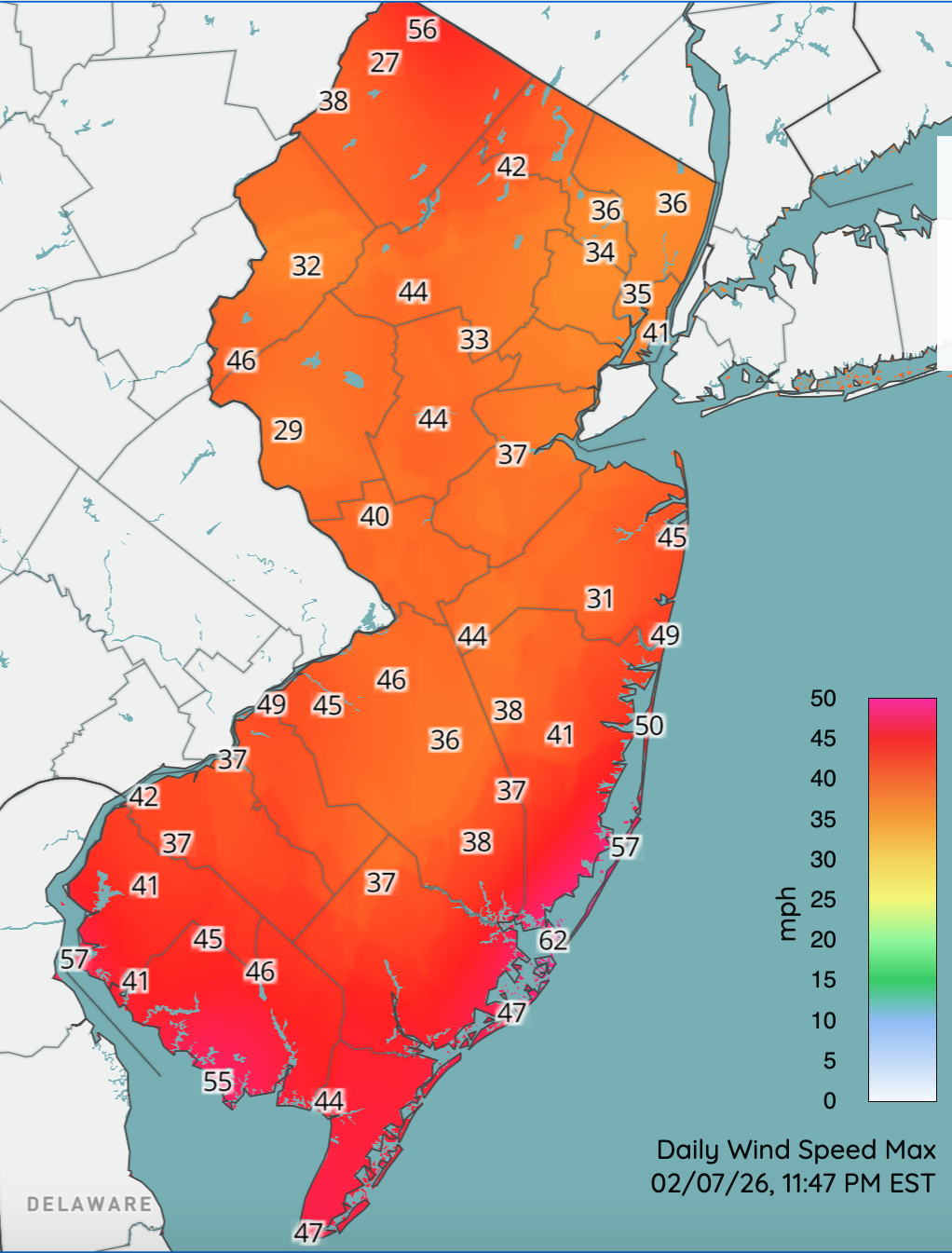
Figure 2. Daily wind speed maximums in mph at NJWxNet stations on February 7th. Not all NJWxNet reports appear on the map.
Light freezing rain early on the 11th, totaling no more than 0.09”, signaled a break in the delivery of Arctic air across the state, accompanied by a 41 mph gust at Harvey Cedars, and 40 mph at both Lower Alloways Creek Township (LACT; Salem) and Mullica Township (Atlantic). HPM reached 40 mph on the 12th. Despite some warming, snow continued to cover the ground throughout NJ as it had been since the storm of January 25th and even since mid-January in central and northern areas. What made this persistent cover even more interesting is that the extent of snow cover was well below normal across the United States (also in many Eurasian locations), while only Mid-Atlantic coverage was above normal. This is shown in the February 13th snow cover map (Figure 3) and in the snow extent departure map, which denotes those few areas (shown in blue) where snow cover is usually not found on this date and those where snow cover is expected but not found (red; Figure 4).
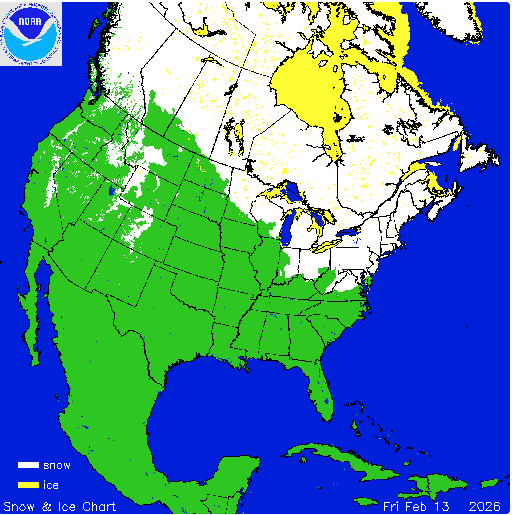
Figure 3. Snow cover across North America on February 13th. Areas covered with snow are white, lake/bay/sea ice (yellow), snow-free land (green), and open water (blue). (NOAA IMS).
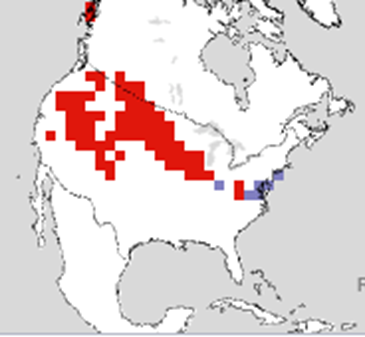
Figure 4. Areas with anomalous snow cover across North America on February 13th. Areas where snow cover is present yet normally is not found on this date are shown in blue. Areas where snow cover is normally found but this year is not found on this date are show in red. Departures are determined using the NOAA IMS product (Rutgers Global Snow Lab).
Evening rain in the south on the 15th ended in the predawn hours of the 16th, while light snow accumulated further north. Top rain totals included Middle Township (Cape May) stations reporting 0.77” and two 0.53” totals, Lower Township (Cape May) with four stations at 0.73”, 0.61”, 0.56”, and 0.52”, and Brigantine (Atlantic) 0.57”. Only ten stations of 277 came in over 0.50”. Measurable snow (≥0.1”) accumulated in 15 counties, with 11 receiving at least 1.0”. Six of these saw at least 2.0”, with top values in each county including Frenchtown (Hunterdon) 2.4”, Pennington (Mercer) and Princeton (Mercer) each 2.0”, Freehold (Monmouth) 2.0”, Chester Township (Morris) 2.3”, Belle Mead (Somerset) and Bernards Township (Somerset) each 2.2”, and Liberty Township (Warren) 2.5”.
Scattered rain and fog during the second half of the 18th into the predawn of the 19th resulted in as much as 0.34”, 0.33”, and 0.30” at three Vernon Township (Sussex) locations and 0.31” at Montague (Sussex).
Late-evening southern rain on the 19th spread over the state by the morning of the 20th before tapering off to afternoon drizzle. This produced the largest rainfall totals of the month, along with some freezing rain at higher northern elevations. Top rain totals included Ocean City with 1.47” and 1.32” at two sites, Dennis Township (Cape May) 1.44”, Woodbine 1.41” and 1.42” at two sites, Middle Township with 1.41”, 1.38”, and 1.37” at three sites, and Maurice River Township (Cumberland) 1.38”. Nineteen of 238 CoCoRaHS stations observed over 1.00” and 176 from 0.50”–0.99” (Figure 5). The anemometer at HPM served as an effective freezing rain indicator as this often-windy site reported a wind speed of zero for hours during and several days following the event (Figure 6). Elsewhere, anemometers spun to speeds of up to 57 mph at LEHT, 41 mph in Harvey Cedars, and 40 mph at Atlantic City Marina (Atlantic).
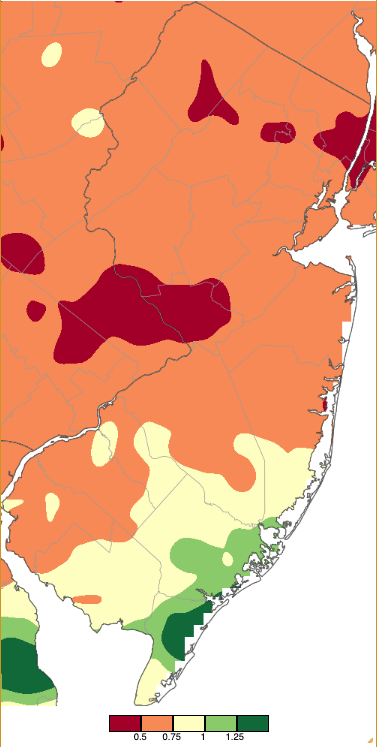
Figure 5. Precipitation across New Jersey from 7 AM on February 18th through 7 AM February 19th based on a PRISM (Oregon State University) analysis generated using NWS Cooperative, CoCoRaHS, NJWxNet, and other professional weather station observations. Note the scale in inches beneath the map.
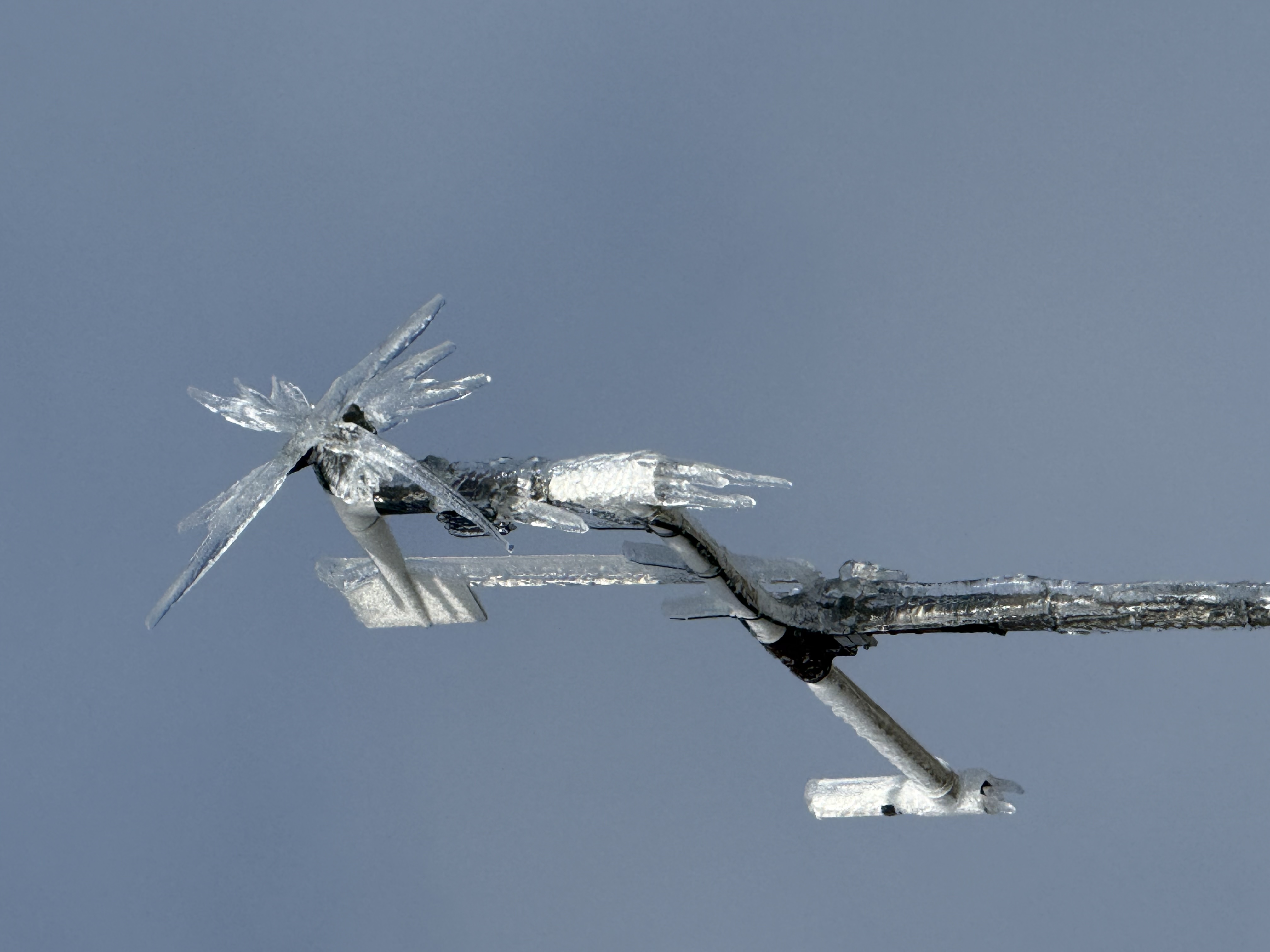
Figure 6. Freezing rain-encased anemometer at the Rutgers NJ Weather Network High Point Monument station on February 21st. (Photo courtesy of Nick Stefano).
The main event of the month and, in all but the northwest, season began as scattered light rain across the south during the predawn hours of the 22nd. This spread north during the morning and, once the intensity of the precipitation increased, surface temperatures cooled enough to result in a turnover to snow. Heavy snow fell during the second half of the day at many locations, continuing into the morning of the 23rd. Winds increased and at some coastal and airport locations such as Newark Liberty (Union), blizzard criteria were reached (three or more consecutive hours of winds over 35 mph and visibility ≤0.25 mile in falling and/or blowing snow). Most areas failed to meet these criteria but were certainly impacted by prodigious amounts of snow. This included some areas located under bands of snowfall exceeding 2”/hour. By the time falling flakes ceased, totals of >10.0” were found in every county except Warren (Figure 7, Table 1). Eight counties received ≥20” in some locations, including Newark Liberty 27.2”, Strathmore (Monmouth) 26.5”, Jackson (Ocean) 25.2”, Matawan (Middlesex) 24.0”, Bergenfield (Bergen) 23.8”, Jersey City (Hudson) 23.0”, Mansfield Township (Burlington) and Columbus (Burlington) each 20.5”, and Chatham (Morris) 20.0”.
The heaviest snows never made it to the northwest due to the offshore nor’easter’s precipitation shield never fully making it that far inland. The top Warren County total was only 9.2” in Hackettstown. This snowfall pattern was somewhat reminiscent of the December 26, 2010, storm that dumped even larger totals than this storm in the east and less in the west.
The rain and melted snow from this storm amounted to as much as 2.40” in Berkeley Township, Long Branch (Monmouth) 2.30”, Beachwood (Ocean) 2.28”, and Linwood 2.26”. Of 150 reports, eleven came in from 2.00”–2.40”, 105 from 1.00”–1.99”, and 36 from 0.50”–0.99”. Top wind gusts included 53 mph at LEHT and 45–48 mph at four other NJWxNet locations on the 22nd, and 57 mph at LEHT, Atlantic City Marina 54 mph, Sea Girt (Monmouth) 48 mph, and 40–44 mph at six other stations on the 23rd. Given the potential of blizzard criteria being reached, it is worth noting the seven other stations gusted from 35–39 mph on the 22nd and eight from 35–38 mph on the 23rd. Fortunately, winds did not blow from the east throughout the storm and push water ashore. Rather, as high tide approached, they began to arrive from the north, thus only minor flooding was observed up and down the coast. The storm had a significant impact on power in the state with reports of over 100,000 outages due to the wind and snow-encrusted falling tree limbs and powerlines.
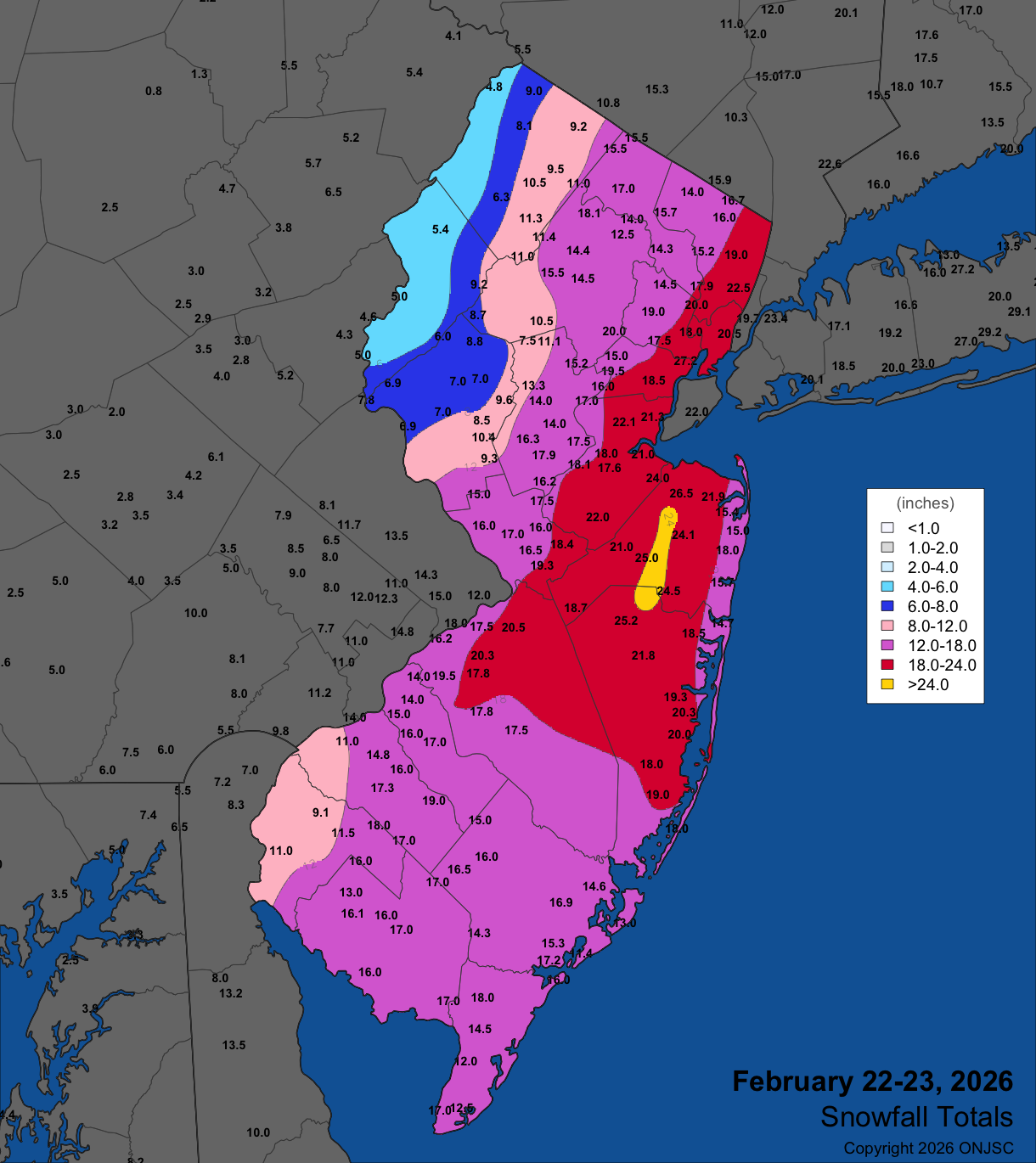
Figure 7. Snowfall on February 22nd–23rd. Observations are from CoCoRaHS, NWS Cooperative Observer, NWS Trained Spotters, and reports from the North Jersey Weather Observers.
| County | Location | Snowfall |
|---|---|---|
| Atlantic | Somers Point | 17.2” |
| Bergen | Bergenfield | 23.8” |
| Burlington | Mansfield Twp & Columbus | 20.5” |
| Camden | Lindenwold | 17.0” |
| Cape May | Woodbine | 18.0” |
| Cumberland | Maurice River Twp & Millville | 17.0” |
| Essex | West Orange Twp | 19.0” |
| Gloucester | Monroe Twp | 19.0” |
| Hudson | Jersey City | 23.0” |
| Hunterdon | Flemington | 11.0” |
| Mercer | Robbinsville Twp | 19.3” |
| Middlesex | Matawan | 24.0” |
| Monmouth | Strathmore | 26.5” |
| Morris | Chatham | 20.0” |
| Ocean | Jackson Twp | 25.2” |
| Passaic | West Milford Twp | 17.0” |
| Salem | Monroeville | 18.0” |
| Somerset | Watchung | 18.0” |
| Sussex | Highland Lakes | 13.4” |
| Union | Newark Liberty AP | 27.2” |
| Warren | Hackettstown | 9.2” |
Table 1. Maximum snowfall for the February 22nd–23rd storm in all NJ counties. Observations are from CoCoRaHS, NWS Cooperative Observer, NWS Trained Spotter, and North Jersey Weather Observers reports.
A clipper system zipped through the state early on the 25th, bringing with it at most 1.5” of snow in Harrison (Hudson), 1.0”–1.2” at 31 CoCoRaHS locations, and 0.1”–0.9” in 84 other spots.
The lowest barometric pressure of the month occurred on the 20th, falling to 29.50”–29.60”. Highest pressures in the 30.25”–30.40” range were observed on the 9th. Each of the ten February days with wind gusts of 40 mph or above has been mentioned above.
Temperature
February began with a continuation of the frigid conditions that prevailed during the second half of January (more on that in the winter section). Below-normal temperatures lasted until mid-month, later to return for a few days toward month’s end. All stations had lows below freezing on 16 days. There was not a day without multiple stations dropping below freezing for a low. One or more of the 70 NJWxNet stations recorded a below-zero minimum on eight of the first nine days of the month. Five days had lows in the single digits above zero at one or more location. The first subzero day was the 1st with HPM at -5°, High Point (Sussex) -2°, Vernon Township -1°, Sandyston (Sussex) and Wantage each 0°, and 33 stations from 1°–10°. Walpack (Sussex) fell to -5° on the 2nd, with ten locations 3°–10°. Walpack reached -8° on the 3rd, followed by Pequest (Warren) -5°, Sandyston -3°, Hackettstown 0°, and 17 sites from 3°-10°. Lower Alloways Creek Township (LACT; Salem) and Fortescue (Cumberland) only dropped to 24°, 32° milder than Walpack. Walpack again led the way at -7° on the 5th, with Pequest and Sandyston each at -1°, and 20 stations from 2°–10°. Pequest reached -1° on the 6th, Walpack 0°, and 25 stations from 1°–10°.
Another shot of cold air blew in on the 7th, with HPM dropping to -6°, High Point -3°, Vernon Township -2°, Sandyston and Wantage each 0°, and 61 sites from 1°–10°. LACT was least cold at 12°. The 8th was the month’s coldest morning, with HPM bottoming out at -9°, High Point and Vernon Township each -6°, eleven stations from -4–0°, and every other NJWxNet station from 1°–9° (Figure 8). LACT and West Cape May (Cape May) were the two sites at 9°. The last subzero morning was the 9th, with Walpack down to -9°, HPM -2°, Sandyston -1°, Pequest 0°, and 62 stations from 1°–10°.
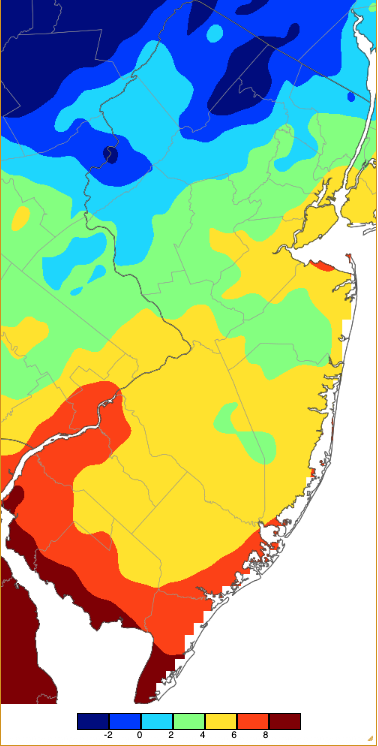
Figure 8. Minimum temperatures on February 8th based on a PRISM (Oregon State University) analysis generated using NWS, NJWxNet, and other professional weather stations.
There were ten February days when one of more NJWxNet station recorded a high of 50° or above. Eight days found all NJWxNet stations with highs above freezing, while three days saw all station maximums below freezing. All 50° days were found from the 14th onward, beginning with a 51° maximum at Mansfield (Burlington) and eight stations at 50° on the 14th. Dennis Township rose to 53° and four sites from 50°–52° on the 15th. Northwestern warmth found Sandyston and Walpack leading the way with highs of 53° on the 17th, with six locations from 50°–51°. Egg Harbor Township (Atlantic) made it to 54° on the 18th, with ten stations 50°–53°. Cape May Court House (Cape May) reached 56°, Greenwich (Cumberland) 55°, and nine stations 50°–53° on the 20th when HPM topped out at just 31°. The 21st found Woodbine up to 53° and 28 sites from 50°–52°.
The last four days of the month found many stations maxing out at 50° or higher, starting with a 50° reading at Cape May Court House on the 25th. Fort Dix (Burlington) and Red Lion (Burlington) hit 52° and eleven sites 50°–51° on the 26th. Highs of 54° were found at Vineland (Cumberland) and Cream Ridge (Monmouth) on the 27th, with 23 locations 50°–53°. The 28th was by far the mildest February day and the warmest statewide since November 26th. Hammonton (Atlantic) peaked at 63°, Fort Dix 62°, nine stations rose to 60°–61°, and 54 from 50°–59° (Figure 9). The nearby cool ocean water led to Sea Girt having the coolest high at 45°.
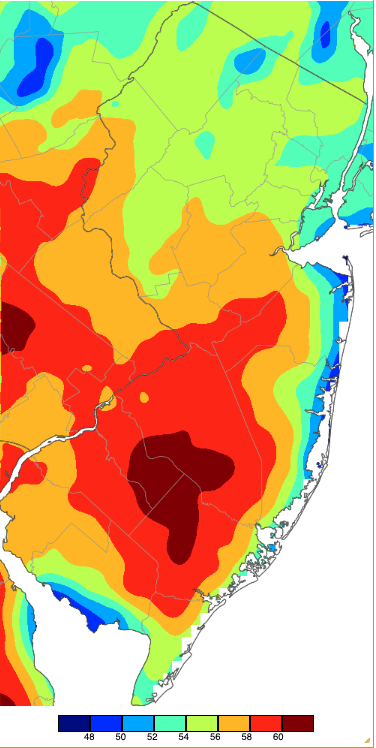
Figure 9. Maximum temperatures on February 28th based on a PRISM (Oregon State University) analysis generated using NWS, NJWxNet, and other professional weather stations.
Winter Overview
The winter of 2025/2026 (December–February) came in below normal in terms of precipitation and temperature for the second consecutive winter. While snowfall was below normal in 2024/2025, it was above normal this past winter. Precipitation (rain and melted snow/sleet) averaged 7.76” (Figure 10). This is 2.86” below the 1991–2020 normal and ranks as the 23rd driest on record. This compares to a 7.07” total and 11th driest ranking last winter. The northern climate division averaged 7.18” (-3.36”, 14th driest), the southern division 8.08” (-2.56”, 27th driest), and the coastal division 8.41” (-2.53”, 30th driest). Among NJ CoCoRaHS stations, the wettest was Berkeley Township (Ocean) 11.80”, followed by Beachwood (Ocean) 11.28”, Stafford Township (Ocean) 11.10”, Galloway Township (Atlantic) 11.04” and 10.98” (two stations), and Point Pleasant Beach (Ocean) 10.83”. The driest locations included Mansfield Township (Warren) 6.80”, Liberty Township (Warren) 6.81”, Greenwich Township (Warren) 6.91”, Blairstown (Warren) 7.01”, and Sparta Township (Sussex) 7.17”.
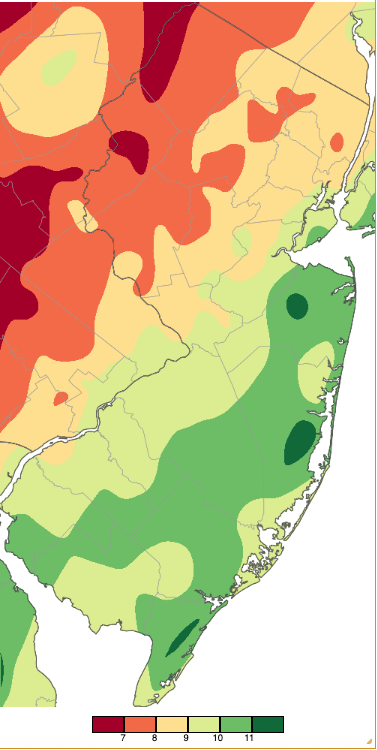
Figure 10. Winter 2025/2026 (December 1st–February 28th) precipitation across New Jersey based on a PRISM (Oregon State University) analysis generated using NWS Cooperative, CoCoRaHS, NJWxNet, and other professional weather station observations. Totals range from 6.00”–6.99” (dark red) to 11.00”–11.99” (dark green).
The US Drought Monitor considered everywhere in the state to be in either abnormally dry or in moderate, severe, or extreme drought at times during the winter. Weekly maps of conditions early and late in the season show conditions to have worsened in the northwest, remained the same or worsened in northeast central, and many southern areas, while easing a bit in the far southwest (Figure 11).
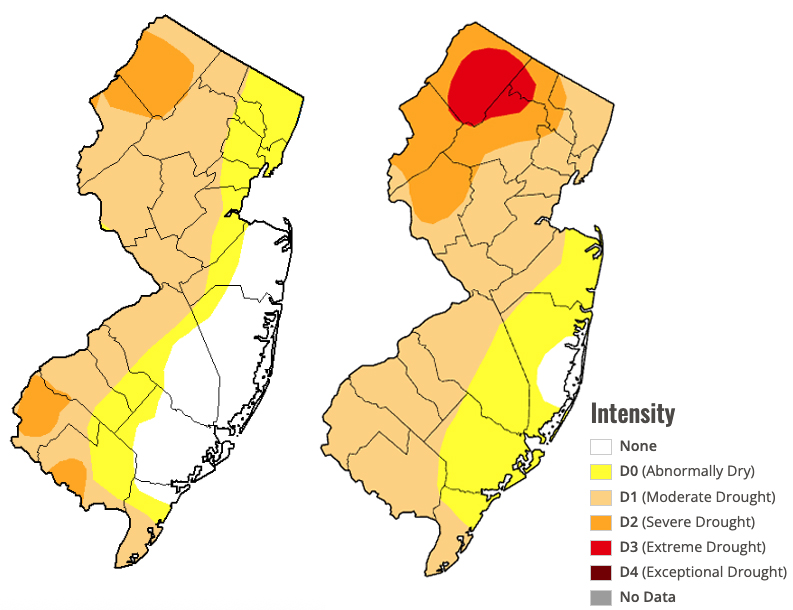
Figure 11. U.S. Drought Monitor map of conditions in NJ as of December 2, 2025 (left) and February 24th, 2026 (right).
Fall 2025 and winter 2025/2026 precipitation averaged 15.68” across the state. This is 6.65” below normal and ranks as the 13th driest on record. As with winter totals, the coast was wettest and northwest driest (Figure 12). This follows a pattern that dates back almost two years. The past 12 months (March 2025–February 2026 have averaged 40.02”, which is 7.54” below normal and ranks as the 24th such driest period. Over the past 22 months (May 2024–February 2026) 19 have averaged below normal. The past 24 months have seen 78.03” of precipitation. This is 17.09” below normal and ranks 7th driest (Table 2).
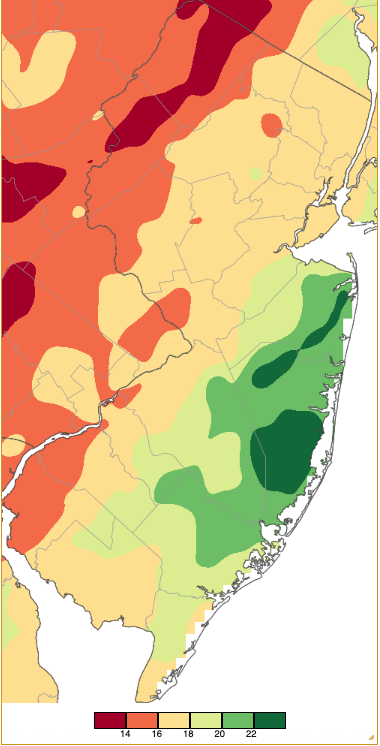
Figure 12. Fall 2025–Winter 2025/2026 (September 1st–February 28th) precipitation across New Jersey based on a PRISM (Oregon State University) analysis generated using NWS Cooperative, CoCoRaHS, NJWxNet, and other professional weather station observations. Totals range from 12.00”–13.99” (dark red) to 22.00”–23.99” (dark green).
| Rank | Years | March (year 1) to February (year 2) Precip. |
|---|---|---|
| 1 | 1964–1966 | 64.98" |
| 2 | 1965–1967 | 67.57" |
| 3 | 1930–1932 | 71.82" |
| 4 | 1963–1965 | 71.90" |
| 5 | 1929–1931 | 73.34" |
| 6 | 1962–1964 | 77.60" |
| 7 | 2024–2026 | 78.03" |
| 8 | 1915–1917 | 78.10" |
| 9 | 1909–1911 | 78.33" |
| 10 | 2000–2002 | 78.50" |
Table 2. The ten driest March (year 1) to February (year 2) twenty-four-month intervals across New Jersey since 1895.
As a result of this persistent dry period, streamflow and groundwater levels remain below normal, and many reservoirs are over 30% below seasonal averages as of late February, some sitting under half full (Figure 13). The entire state remained under a NJ Department of Environmental Protection Drought Warning throughout the winter, the same as winter 2024/2025.
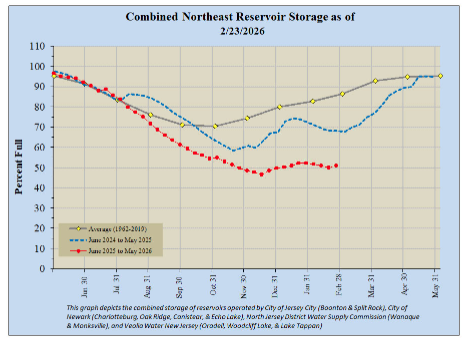
Figure 13. Reservoir storage (percent) in Northeast NJ reservoirs. The red line represents storage from June 2025-February 23, 2026, blue line storage from June 2024–May 2025, and gray line average storage based on observations from 1962–2019. Graph depicts the combined storage of reservoirs operated by Jersey City (Boonton & Split Rock), Newark (Charlotteburg, Oak Ridge, Canistear, & Echo Lake), North Jersey District Water Supply Commission (Wanaque & Monksville), and Veolia New Jersey (Oradell, Woodcliff Lake, & Lake Tappan). (NJ Department of Environmental Protection).
Winter snowfall averaged 37.8” across the state. This is 18.1” above normal and ranks as the 12th snowiest winter. It is well above last winter’s 14.6” and is the snowiest since winter 2013/2014. As no measurable snow fell in November, this represents season-to-date totals through February. The northern snow division averaged 47.3” (+21.0”, 13th snowiest), the central division 42.9” (+21.3”, 10th snowiest), and the southern division 30.2” (+14.8”, 16th snowiest). Top snowfall totals for the winter included two Vernon Township (Sussex) reports of 64.0” (higher elevation location) and 51.5” (lower elevation). Also near the top is Mine Hill Township (Morris) at 58.5”, Randolph Township (Morris) 54.3”, Sparta Township 51.2”, and Rockaway Township (Morris) 50.5”.
Winter temperatures across NJ averaged 29.7°. This is 4.3° below normal and ranks as the 36th coldest since 1895. It was the coldest winter since 2014/2015 and, with last winter, the second below normal since 2017/2018. The last two winters had all three winter months below normal, something not seen in any prior winter since 2013/2014. The northern division averaged 26.9° (-4.5°, 35th coldest), southern division 31.4° (-4.3°, 35th coldest), and coastal division 32.2° (-4.3°, 36th coldest). With November 2025 experiencing below-normal temperatures, it marked four consecutive months of below-normal temperatures for the first time since December 2013–March 2014 (including November 2013 made it five consecutive below–normal months).
Just a few scattered locations had a winter day with a high exceeding 60°, while most seasonal highs were from 56°–60° in the south and 54°–58° in the north (Figure 14). On the low end of the thermometer, seasonal extreme minimums were below -5° in the northwest and a portion of the Pinelands (Figure 15). Otherwise, they were between -5° and +5° in most areas both north and south, the exceptions being urban areas and along the Atlantic and Delaware Bay coasts, where slightly milder minimums occurred.
Late January into early February was the most persistently cold interval of a cold winter. A few National Weather Service (NWS) stations with multi-decadal records exemplify this. At Trenton (Mercer), the 17.3° average temperature from January 24th to February 9th was the coldest 17-day period since January 7th–23rd, 1984, with the first nine days of February bringing the coldest start of the month since 1934. At the Atlantic City Airport in Pomona (Atlantic), this 17-day period averaged 20.5°, the coldest since February 13th–March 1st, 2015, with the February start the coldest since 1996. At Atlantic City Marina (Atlantic), the 21.9° 17-day average was the coldest since February 4th–20th, 1979, and the coldest early February since 1934. At the High Point Monument (Sussex) NJWxNet station, the temperature remained below freezing for 22 consecutive days (January 23rd to February 13th). Looking back at NWS Cooperative station records at this location from 1956–2005 (when the station closed), this tied with three other years for the fifth longest sub-freezing run, trailing 27 days in 1985, 26 in 1968, 24 in 1989, and 23 in 1977. This year, 15 of the last 16 days of January failed to exceed freezing as did 15 of the first 16 days of February.
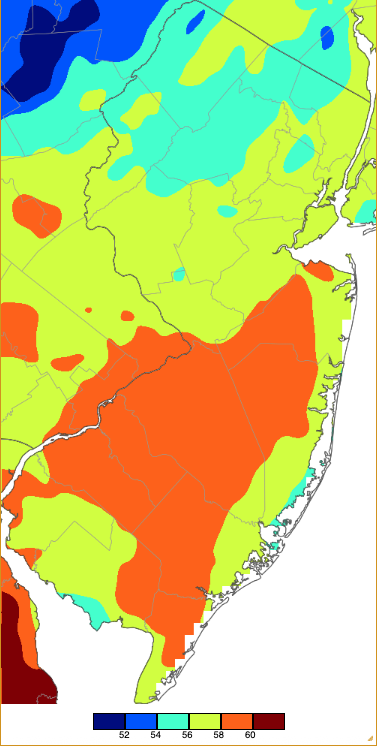
Figure 14. Extreme maximum temperatures during winter 2025/2026 based on a PRISM (Oregon State University) analysis generated using NWS, NJWxNet, and other professional weather stations. The seasonal maximum occurred on different days at different locations.
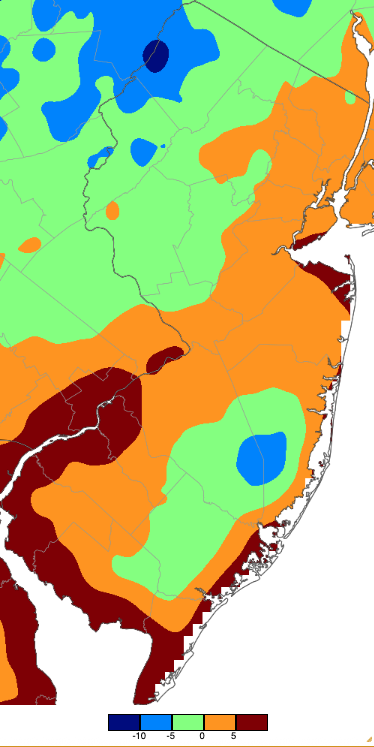
Figure 15. Extreme minimum temperatures during winter 2025/2026 based on a PRISM (Oregon State University) analysis generated using NWS, NJWxNet, and other professional weather stations. The seasonal minimum occurred on different days at different locations.