
Spring

Thermal Whiplash: April 2026 Recap (and 2025/2026 Snow Season overview)
May 8, 2026 - 1:05pm -- Dave Robinson

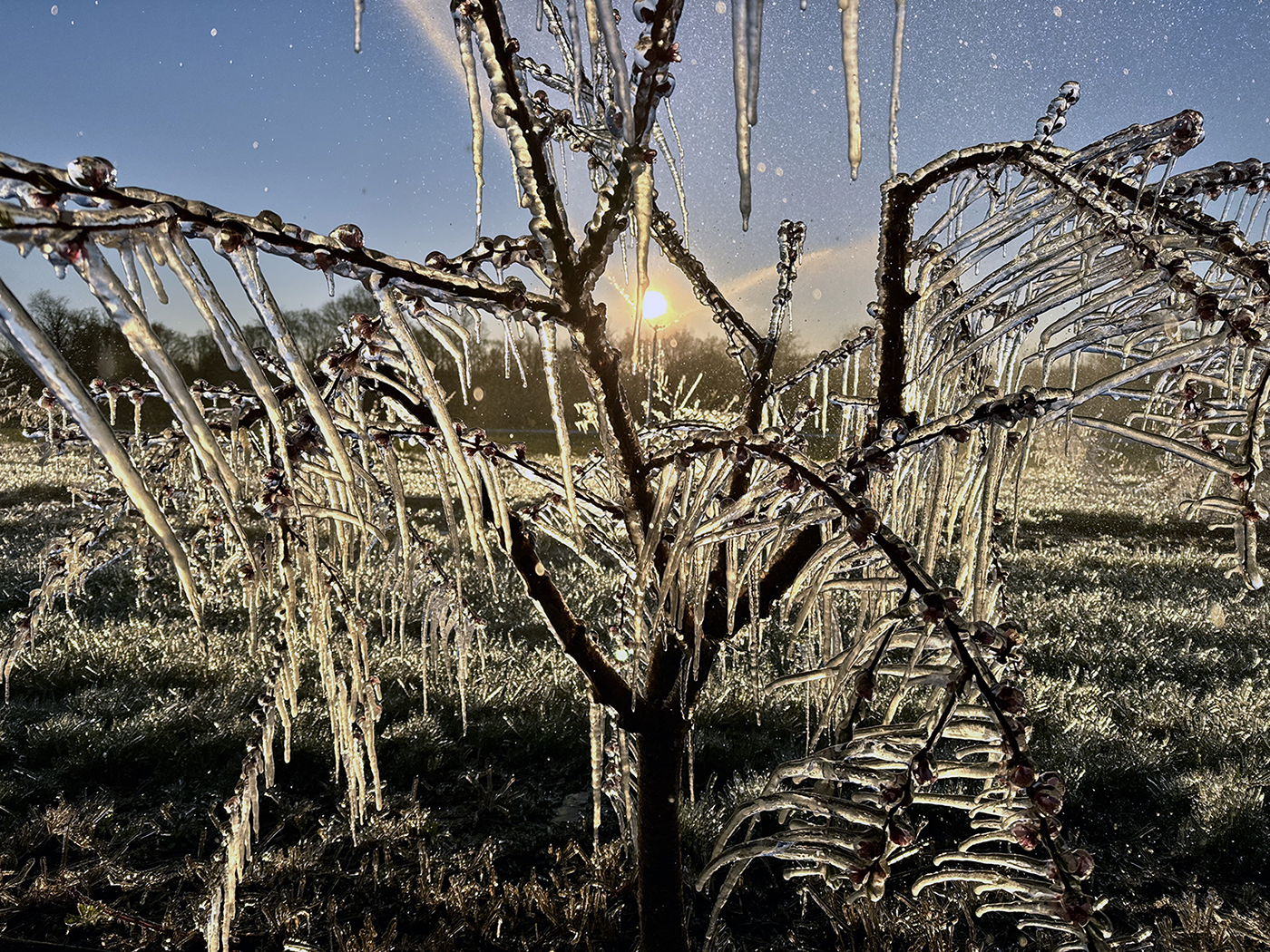
Ice-encased peach tree branches at 6:30 AM on April 8th.  Water was sprayed on the trees at the Stephen Specca Farms in Jacksonville (Springfield Township, Burlington County) to provide insulative ice cover, protecting the buds from temperatures that fell into the upper 20°s. Photo courtesy of D. Specca.

April 2026 was a month ranking in the top ten for warmth, yet the major weather news of the month was a damaging late-month freeze. Weeks vacillated between warmth and cold, with the warm ones winning out. This thermal whiplash was accompanied by yet another below-normal month of precipitation, making this 21 of the past 24 months with below-normal totals across the Garden State. A Drought Warning issued by the NJ Department of Environmental Protection remains in place.

The 54.4° average April temperature is 2.9° above the 1991–2020 normal. This ties as the 6th mildest since records commenced in 1895. Seven of the ten mildest Aprils have occurred since 2002, with 2006 (12th) and 2025 (13th) not far behind. The average high of 66.4° is 3.7° above normal, ranking 6th mildest, and the average low of 42.4° is 2.1° above normal, ranking 7th mildest. The northern climate division averaged 52.9° (+3.0°, 6th mildest), the southern division 55.5° (+2.9, 6th mildest), and the coastal division 54.2° (+2.5°, 8th mildest).

April precipitation averaged 2.51” across NJ. This is 1.19” below normal and ranks as the 23rd driest. The northern division averaged 2.84” (-1.06”, 39th driest), southern 2.31” (-1.27”, 18th driest), and coastal 2.33” (-1.22”, 25th driest). Northwest areas were closest to normal, with west central and far southern reaches driest. Only trace amounts of snow and sleet were observed in several locations during the month.

Emerging from Dormancy: March 2026 Recap

April 7, 2026 - 5:42pm -- Dave Robinson

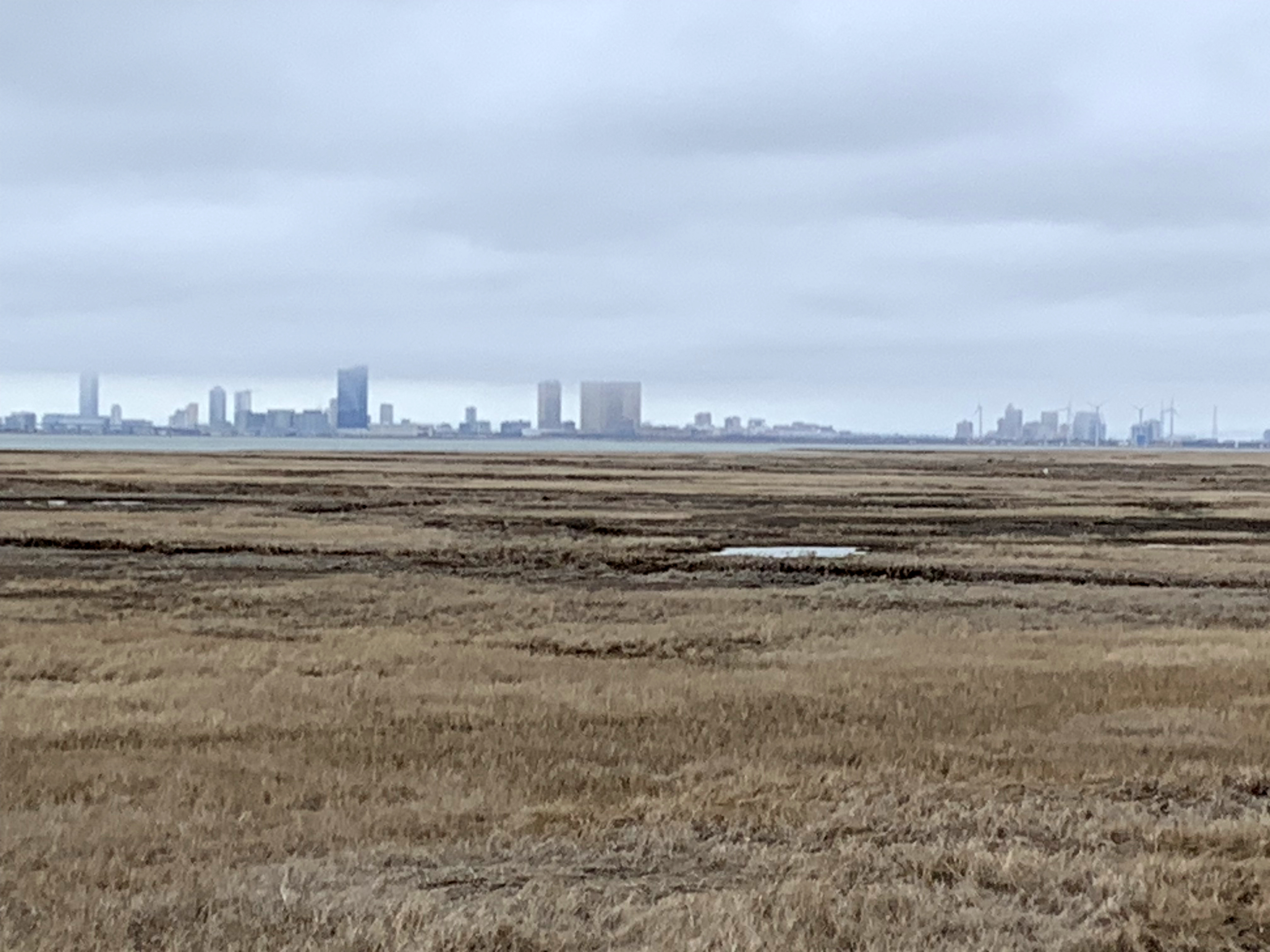
Low clouds hover over Atlantic City as seen from the Forsythe Wildlife Refuge in Galloway Township (Atlantic County) on March 6th. Photo by Dave Robinson.

As is common as winter transitions into spring, this weather/climate shift came in fits and starts this March. Included were some rapid thermal flips, occasional powerful winds, and enough rain in the north to ease drought concerns but well below-normal rain in the south, a region that during winter had been leading the way with beneficial precipitation. The only thing mostly missing, for the third consecutive March, was snowfall, as the persistent snow and ice cover of recent months quickly melted.

With a statewide ranking of 12th warmest, March 2026 is the eighth over the past 26 years to rank in the top 15 with records dating back to 1895. The 45.1° statewide average is 4.1° above the 1991–2020 normal. The average high of 55.9° is 5.0° above normal and ranks 11th mildest. The average low of 34.3° is 3.1° above normal and ranks 14th mildest. Regionally, the northern division averaged 42.9° (+4.1°, 12th mildest), the southern division 46.6° (+4.2°, 12th mildest), and the coastal division 45.9° (+3.7°, 12th mildest).

Statewide, March precipitation averaged 3.28”. This is 0.92” below normal, ranking as the 47th driest on record. The north came in at 4.78” (+0.77”, 30th wettest/103rd driest), the south 2.37” (-1.95”, 21st driest), and the coast 2.24” (-2.18”, 16th driest). The overall below-normal NJ precipitation pattern dates to May 2024, with 20 of the past 23 months below normal. Thus, NJ remained in a NJ Department of Environmental Protection Drought Warning and all of the state was in a stage of moderate drought or abnormal dryness according to the US Drought Monitor at month’s end.

Oh, What A Relief It Is: May and Spring 2025 Recaps

June 5, 2025 - 3:18pm -- Dave Robinson

Photo of the Tour of Somerville bicycle race, held on the sunny and dry afternoon of May 26th.

It took a frustratingly long time for the cool season “recharge” of New Jersey’s water resources to get well underway. Following a record dry fall 2024, December through April precipitation remained below normal, including the third driest January of the past 131 years. However, February, March, and April precipitation totals were only a bit below normal, so while precipitation deficits were not recovering, they did not worsen, and reservoirs began to fill. Then along came May, with near record-high precipitation, just in time to bring most water resources up to normal heading into summer. Yes, quite a relief! The only cautionary note regards groundwater deficits that remain at some locations in the sandy substrate of south Jersey. This impacts local streamflow as well once runoff from any recent rains has diminished, leaving the streams fed by depleted spring waters. Thus, the NJ Department of Environmental Protection has not lifted the drought warning that was established in mid-November 2024.

As for May, the statewide average precipitation was 7.27”. This was 3.52” above the 1991–2020 normal and ranks as the 5th wettest May since statewide records became established in 1895. It is the wettest May since 1990, and the fifth May this century to fall into the top 25 (three have been in the driest 25).

May temperatures exhibited some notable swings, with the end of the month’s below-normal conditions just about balancing out the above-normal start. The statewide average of 62.0° was 0.8° above normal and ranks as the 30th mildest of the past 131 years. The statewide average high temperature was 71.5°, which was 0.8° below normal and ranked as the 65th warmest/66th coolest on record. Meanwhile, the 52.5° average low was 2.3° above normal, ranking as the 12th mildest. This sign disparity is the result of the frequent cloudy and wet conditions that suppressed both daytime warmth and nighttime cooling.

Spring Arrives for Certain: March 2025 Recap

April 10, 2025 - 4:08pm -- Dave Robinson

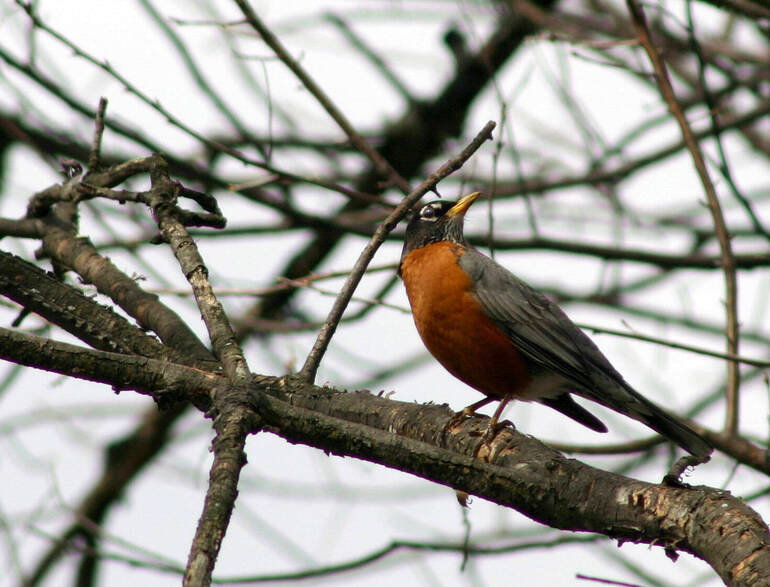
A Robin signals the arrival of spring in Hawthorne (Passaic County) on March 20th. Photo by Judy Kopitar.

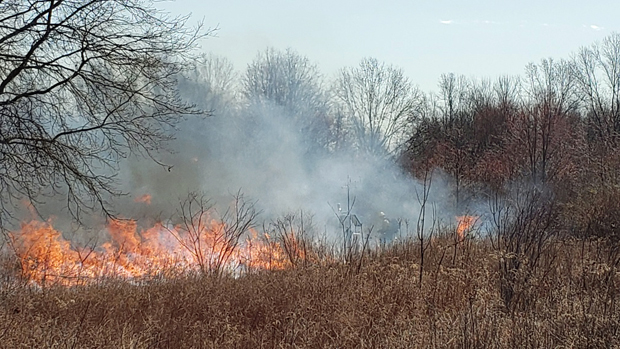
Some Marches in past years have kept you guessing when, sometimes even if, spring will arrive. That certainly was not the case this year, nor, for that matter, has it been much so in recent years. With a statewide ranking of tenth warmest, March 2025 was the fourth of the past ten years to rank in the top ten. Eight of the sixteen mildest Marches in the past 131 years have occurred since 2000. Not even a late-season snow event occurred to temporarily stifle spring fever, as no measurable snow was observed anywhere in the state. Spring showers arrived and were plentiful enough to approach the statewide monthly normal. However, March finished as the seventh consecutive and tenth of the past eleven months with below-normal precipitation. As a result, there were multiple wildfires, rather common in NJ springs.

Looking more closely at numbers, the statewide March average temperature of 45.7° was 4.7° above the 1991–2020 normal and, as mentioned previously, ranked as the tenth mildest since records commenced in 1895. The average high was 57.2°, which is 6.3° above normal and ranks sixth mildest. The average low was closer to normal at 34.1°, which is 2.9° above normal and ranks thirteenth mildest (tied with three other years). The northern climate division averaged 43.6° (+4.8°, 11th mildest), the southern division 47.0° (+4.6°, 10th mildest), and the coastal division 46.4° (+4.2°, 9th mildest).

A Little of This, a Little of That/Mild and Damp: May/Spring 2024 Recaps

June 7, 2024 - 5:08pm -- Dave Robinson

A rainbow (note a slight double rainbow) early on the evening of May 15th, looking east from Shawnee, PA, across the Delaware River with the NJ Kittatinny Ridge in the background (photo courtesy of Erin Daly).

As spring turns to summer, all in Jersey can be pleased that water supplies are in good shape. Also, while it took some time to become established, by late May, warmer temperatures brought out summer wardrobes. Spring (March–May) conditions will be covered later in this report, but first a look at May. As the title of the monthly portion of this narrative suggests, May 2024 never established a consistent atmospheric pattern. There were plenty of episodes where light to moderate showers dotted the state, but never a broad soaker. Temperatures fluctuated on a weekly basis, without a persistent leaning until warmth prevailed later in the month. Put it all together and May ended on a green note born of somewhat below-normal precipitation and above-normal temperatures. The statewide average temperature of 63.9° was 2.7° above the 1991–2020 normal. This ranks as the 11th mildest May dating back to 1895. This anomaly was driven by elevated minimum temperatures that averaged 54.0° which is 3.8° above normal and ranks as the 4th warmest on record. This no doubt due to persistent nighttime cloud cover. The average high temperature of 73.7° was 1.4° above normal, ranking 35th warmest. The northern climate division averaged 63.0° (+3.1°, 7th warmest). Across the southern division the average temperature was 64.5° (+2.3°, 13th warmest). The coastal division averaged 63.1° (+2.1°, 11th warmest).

In the End...Rather Normal: April 2024 Recap

May 7, 2024 - 7:32pm -- Dave Robinson

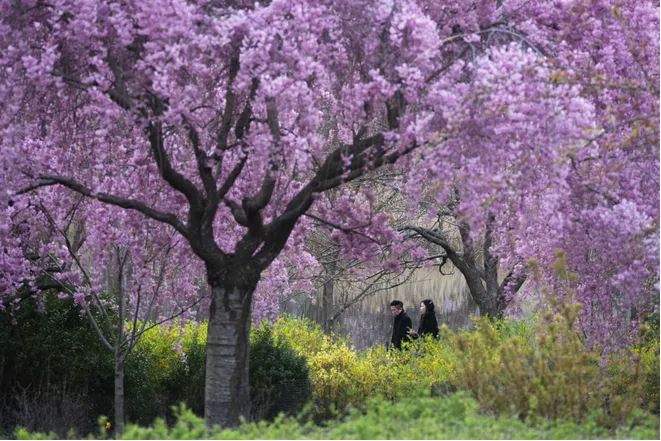
Cherry Blossom trees in full bloom at Branch Brook Park in Newark (Essex County) on April 10th. Photo by Tariq Zehawi/NorthJersey.com.

You would never have guessed it by looking at most days, with some wet, some dry, some warm, some cold, but put it all together and a rather normal April temperature- and precipitation-wise emerged from quite a variety of days and weeks. This is often the case during a transitional month (mid-fall or mid-spring), but this month took it to a bit of an extreme. Toss in a partial solar eclipse and an earthquake and it was quite the month for all who enjoy observing our fascinating world and solar system.

April precipitation averaged 4.14” across New Jersey. This is 0.44” above the 1991–2020 normal and ranks as the 42nd wettest of records dating back to 1895. Generally, the north received more rain than the south. The north climate division averaged 4.59” (+0.69”, 40th wettest), south division 3.89” (+0.31”, 48th wettest), and coastal division 3.65” (+0.10”, 61st wettest).

The year-to-date precipitation (rain and melted frozen precipitation) is 19.86”. This is 5.61” above normal and ranks as the 5th wettest January–April period on record. The top total is 22.98” in 1983 and the second through four wettest occurred in 1979, 1958, and 1953. The past 12 months have seen a state average 56.98” of precipitation, which is the 6th wettest of all such May–April periods dating back to 1895.

The Lion Roars: March 2024 Recap

April 5, 2024 - 8:04pm -- Dave Robinson

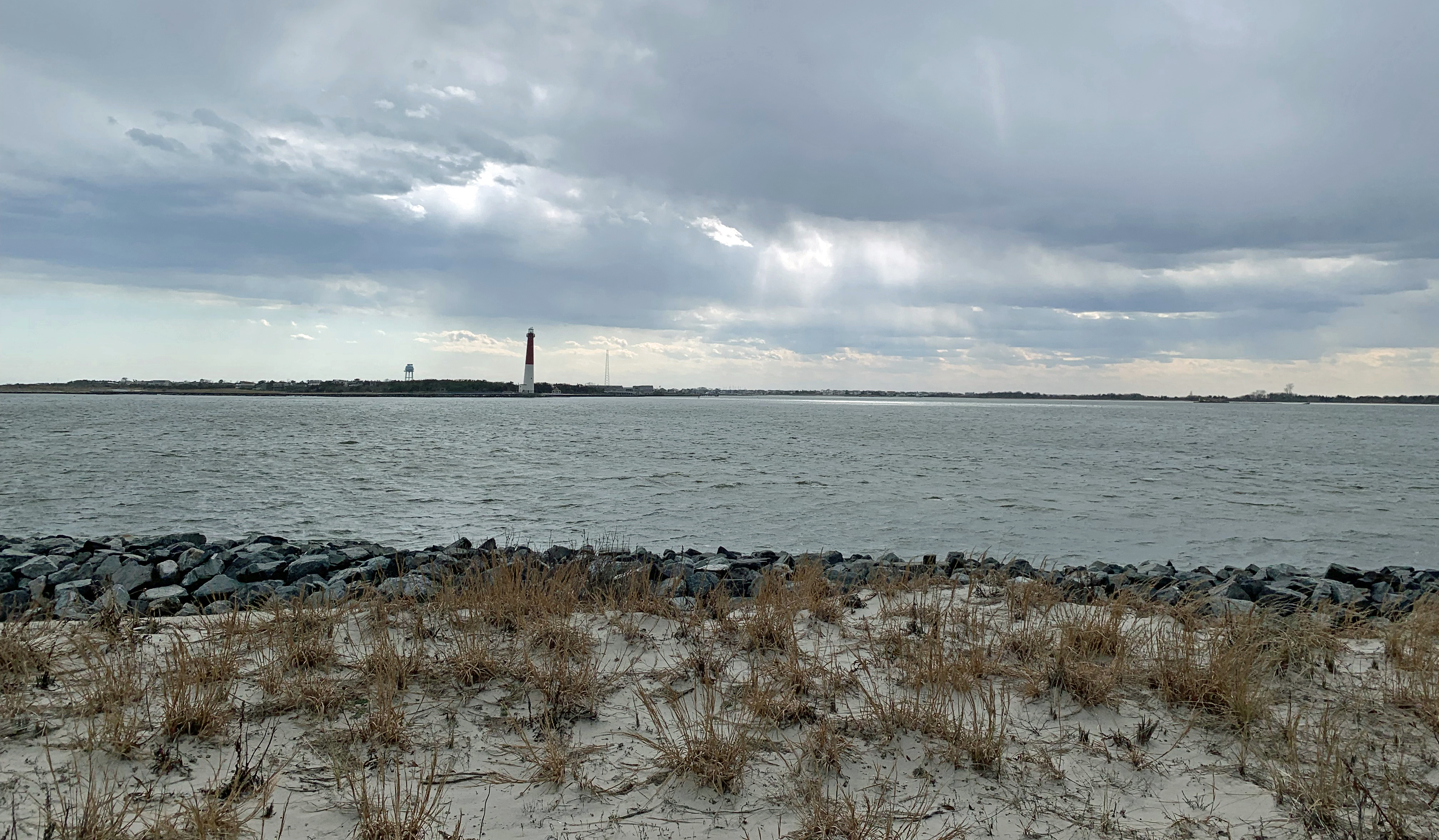
Looking south from Island Beach State Park toward Long Beach Island and the Barnegat Lighthouse on March 20th (photo by Dave Robinson).

So much for March flipping from lion to lamb or vice versa. March 2024 was often a lion throughout, with frequent roaring winds and multiple rain events producing a near-record monthly precipitation total and occasional flooding. The first half of the month ran at a record-warm pace, the monthly average later to be tempered by a second half that was cooler than the first. Still, the month emerged as the 9th mildest on record. Befitting the overall mild conditions, snowfall was scarce to non-existent.

Winds gusted to 35 mph or higher at one or more Rutgers NJ Weather Network (NJWxNet) station on 16 days, exceeding 40 mph on 11 of those days. Precipitation (rain and the water equivalent of the very little snow that fell) averaged 7.76” across the state. This is 3.56” above the 1991–2020 normal and ranks as the third wettest March since records commenced in 1895. The northwest was least wet with 6.00”–7.00” falling. Totals increased to the southeast where near coastal areas received 9.00”–10.00”. The northern climate division averaged 7.01” (+3.00, 6th wettest), the southern division 8.15” (+3.83”, 3rd wettest), and the coastal division 8.98” (+4.56, 2nd wettest).

The statewide average March temperature was 46.0°. This is 5.0° above normal and ranks as the 9th mildest of the past 130 years. The average high temperature of 55.6° was 4.7° above normal and ranks 10th mildest. The average low of 36.3° was 5.1° above normal and ranks 4th mildest. The northern division averaged 43.9° (+5.1°, 9th mildest), southern division 47.2° (+4.8°, 8th mildest), and coastal division 47.0° (+4.8°, 7th mildest).

Smoke Gets In Your Skies, and Another Mild One: May and Spring 2023 Recaps

June 7, 2023 - 6:43pm -- Dave Robinson

Wildfire smoke from western Canada contributed to a scenic sunrise on May 11 in Brigantine (Atlantic County). Photo courtesy of Connie Pyatt Photography.

When the headline for this monthly report alludes to hazy May skies that were frequently overhead, you know it was a quiet period weather-wise across the Garden State. Such was the case during the middle two weeks of May and at month’s end, with smoke from wildfires in western Canada frequently passing well overhead, followed by smoke from fires in Nova Scotia and a few in NJ. Otherwise, May temperatures were cooler than normal, and rainfall sparse.

The statewide average temperature of 59.3° was 1.9° below the 1991–2020 normal. This ranked as the 52nd coolest May since 1895. It was the coolest month compared to normal since January 2022. Following the third mildest April on record, May was only 4.0° milder than the previous month. This is the third smallest temperature difference on record between these two months. The average high temperature of 71.7° was 0.6° below normal, ranking 60th warmest and 68th coolest. The average low temperature of 46.9° was 3.3° below normal, ranking 26th coolest. The northern division averaged 57.8° (-2.1°, 50th coolest), the southern division 60.3° (-1.9°, 50th coolest), and the coastal division 59.6° (-1.4°, 63rd coolest).

An Odd One: April 2023 Recap

May 8, 2023 - 5:15pm -- Dave Robinson

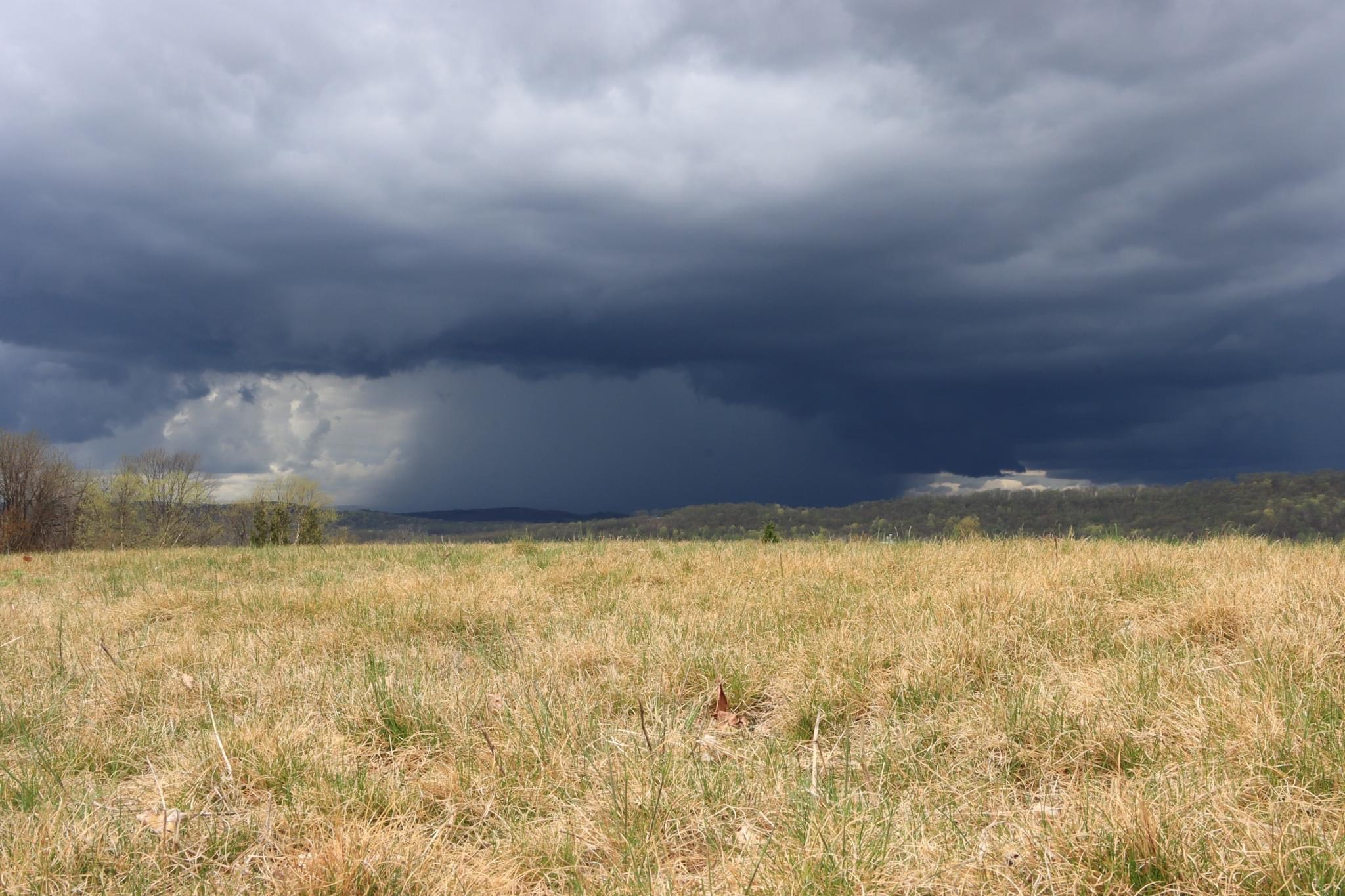
A vivid rain shaft accompanies a thunderstorm as seen from Hardyston Twp. (Sussex County) on April 15th, 2023. Photo courtesy of Yulia Karpova.

What can you say about a month that began with a swarm of tornadoes, finished with flooding rain, and in between, featured record heat, wildfires, and increasing drought concerns? Best to say that it was an odd one! Fitting this theme, the statewide average temperature of 55.4° was 3.9° above the 1991–2020 normal. This ranks as the third warmest April on record (since 1895) only behind 2017 and 2010 for top honors. April was the fifth month of the past ten ranking in the top 10, joining July (#7), August (#1), January (#1), and February (#5). The first four months of 2023 come in as the warmest start of the year on record with an average of 44.4°. This exceeds the previous record of 44.2° in 2012, with seven of the 10 warmest January–April periods (1895–present) occurring since 2002. The average April maximum temperature across NJ was 67.4° (+4.7°, 3rd warmest) and the average minimum was 43.4° (+3.1°, 5th warmest). Northern counties averaged 53.5° in April (+3.6°, 5th warmest), southern counties 56.6° (+4.0, 2nd warmest), and the coastal zone 55.8° (+4.1°, 2nd warmest).

April precipitation averaged 5.84” across New Jersey. This was 2.14” above normal, ranking as the 10th wettest on record. It was the wettest April since 2007 and second wettest since 1983. All but scattered areas in the northwest received above-normal precipitation, the greatest amounts falling near the Atlantic and Delaware Bay coasts. Northern counties averaged 5.55” (+1.65”, 26th wettest), southern counties 6.04” (+2.49”, 7th wettest), and the coastal zone 5.94” (+2.39”, 10th wettest). It is important to note that these totals and those for individual stations in the next section, do not include heavy rain that fell after standard early morning observation times at CoCoRaHS and National Weather Service Cooperative stations on April 30th. These rains were reported in morning observations on May 1st, thus will be included in May totals.

Tempered Spring Advance: March 2023 Recap

April 8, 2023 - 3:52pm -- Dave Robinson

Controlled burn conducted near the Basking Ridge (Lord Sterling Park, Somerset County) Rutgers NJ Weather Network station by NJ Fire Service personnel on March 27th. Photo courtesy of Stephen Federico/Somerset County Park Commission.

While March temperatures came in above normal, they were not nearly as anomalously mild as those seen in January and February. This quelled concerns that an early blooming season might arise, one that could result in damaged vegetation had an early bloom been followed by an unseasonable cold spell. The average March temperature across NJ was 42.1°. This was 1.2° above the 1991–2020 normal and ranks as the 30th mildest March since 1895. The average maximum temperature of 52.2° was 1.3° above normal, ranking 37th mildest. The average minimum of 32.1° was 0.9° on the mild side, ranking 29th mildest. The National Centers for Environmental Information northern division averaged 39.8° (+1.0°, 31st mildest), the southern division 43.5° (+1.1°, 31st mildest), and the coastal division 43.7° (+1.5°, 23rd mildest).

Statewide, precipitation averaged 2.75”, which is 1.45” below normal and ranks 29th driest of the past 129 years. The northern coast and northeast were wettest and the southwest and far south driest. This was reflected in the northern division averaging 3.07” (-0.94”, 44th driest), southern 2.52” (-1.80”, 24th driest), and coast 2.84” (-1.58”, 30th driest).

March statewide average snowfall was 1.8”. This was 2.8” below normal and ranks as 49th least snowy. Northern counties averaged 5.4” (-1.8”, 56th least snowy), central counties 1.5” (-3.9”, 46th least snowy), and southern counties 0.0” (-2.7”, tied with 37 other years as least snowy).

Pages

Subscribe to RSS - Spring